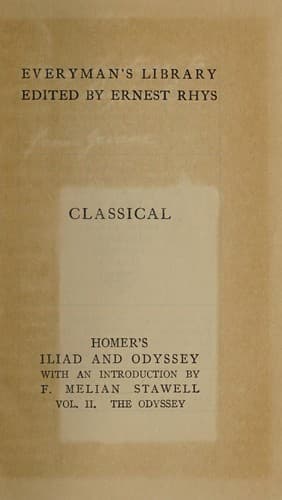
Epic poetry, Greek -- Translations into English; Homer -- Translations into English; Odysseus, King of Ithaca (Mythological character)
Therewith grey-eyed Athene departed over the unharvested seas, and left
pleasant Scheria, and came to Marathon and wide-wayed Athens, and
entered the good house of Erechtheus. Meanwhile Odysseus went to the
famous palace of Alcinous, and his heart was full of many thoughts as
he stood there or ever he had reached the threshold of bronze. For
there was a gleam as it were of sun or moon through the high-roofed
hall of great-hearted Alcinous. Brazen were the walls which ran this
way and that from the threshold to the inmost chamber, and round them
was a frieze of blue, and golden were the doors that closed in the good
house. Silver were the door-posts that were set on the brazen
threshold, and silver the lintel thereupon, and the hook of the door
was of gold. And on either side stood golden hounds and silver, which
Hephaestus wrought by his cunning, to guard the palace of great-hearted
Alcinous, being free from death and age all their days. And within were
seats arrayed against the wall this way and that, from the threshold
even to the inmost chamber, and thereon were spread light coverings
finely woven, the handiwork of women. There the Phaeacian chieftains
were wont to sit eating and drinking, for they had continual store.
Yea, and there were youths fashioned in gold, standing on firm-set
bases, with flaming torches in their hands, giving light through the
night to the feasters in the palace. And he had fifty handmaids in the
house, and some grind the yellow grain on the millstone, and others
weave webs and turn the yarn as they sit, restless as the leaves of the
tall poplar tree: and the soft olive oil drops off that linen, so
closely is it woven. For as the Phaeacian men are skilled beyond all
others in driving a swift ship upon the deep, even so are the women the
most cunning at the loom, for Athene hath given them notable wisdom in
all fair handiwork and cunning wit. And without the courtyard hard by
the door is a great garden, off our ploughgates, and a hedge runs round
on either side. And there grow tall trees blossoming, pear-trees and
pomegranates, and apple-trees with bright fruit, and sweet figs, and
olives in their bloom. The fruit of these trees never perisheth neither
faileth, winter nor summer, enduring through all the year. Evermore the
West Wind blowing brings some fruits to birth and ripens others. Pear
upon pear waxes old, and apple on apple, yea and cluster ripens upon
cluster of the grape, and fig upon fig. There too hath he a fruitful
vineyard planted, whereof the one part is being dried by the heat, a
sunny plot on level ground, while other grapes men are gathering, and
yet others they are treading in the wine-press. In the foremost row are
unripe grapes that cast the blossom, and others there be that are
growing black to vintaging. There too, skirting the furthest line, are
all manner of garden beds, planted trimly, that are perpetually fresh,
and therein are two fountains of water, whereof one scatters his
Public-domain text, read in full here on John Shaqi.
Reviews
Reviews
No reviews yet
Be the first to share your thoughts on this work.
Elsewhere in the archive
Join the Discussion
Join the discussion
Sign in to leave a comment or review.
Sign InorCreate an account