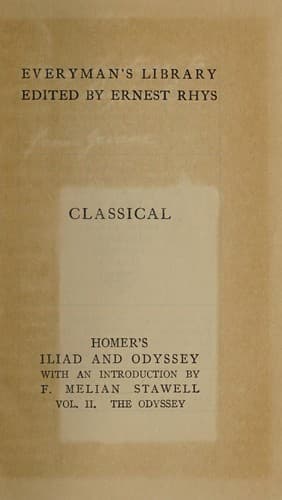
Epic poetry, Greek -- Translations into English; Homer -- Translations into English; Odysseus, King of Ithaca (Mythological character) -- Poetry
The seamen gave her to be fishes' food,
And I survived to mourn her. But the winds
And rolling billows them bore to the coast
Of Ithaca, where with his proper goods
Laertes bought me. By such means it chanced
That e'er I saw the isle in which I dwell.
To whom Ulysses, glorious Chief, replied.
Eumæus! thou hast moved me much, thy woes
Enumerating thus at large. But Jove
Hath neighbour'd all thy evil with this good, 590
That after num'rous sorrows thou hast reach'd
The house of a kind master, at whose hands
Thy sustenance is sure, and here thou lead'st
A tranquil life; but I have late arrived,
City after city of the world explored.
Thus mutual they conferr'd, nor leisure found
Save for short sleep, by morning soon surprized.
Meantime the comrades of Telemachus
Approaching land, cast loose the sail, and lower'd
Alert the mast, then oar'd the vessel in. 600
The anchors heav'd aground,[71] and hawsers tied
Secure, themselves, forth-issuing on the shore,
Breakfast prepared, and charged their cups with wine.
When neither hunger now, nor thirst remained
Unsatisfied, Telemachus began.
Push ye the sable bark without delay
Home to the city. I will to the field
Among my shepherds, and, (my rural works
Survey'd,) at eve will to the town return.
To-morrow will I set before you wine 610
And plenteous viands, wages of your toil.
To whom the godlike Theoclymenus.
Whither must I, my son? who, of the Chiefs
Of rugged Ithaca, shall harbour me?
Shall I to thine and to thy mother's house?
Then thus Telemachus, discrete, replied.
I would invite thee to proceed at once
To our abode, since nought should fail thee there
Of kind reception, but it were a course
Now not adviseable; for I must myself, 620
Be absent, neither would my mother's eyes
Behold thee, so unfrequent she appears
Before the suitors, shunning whom, she sits
Weaving continual at the palace-top.
But I will name to thee another Chief
Whom thou may'st seek, Eurymachus, the son
Renown'd of prudent Polybus, whom all
The people here reverence as a God.
Far noblest of them all is he, and seeks
More ardent than his rivals far, to wed 630
My mother, and to fill my father's throne.
But, He who dwells above, Jove only knows
If some disastrous day be not ordain'd
For them, or ere those nuptials shall arrive.
While thus he spake, at his right hand appear'd,
Messenger of Apollo, on full wing,
A falcon; in his pounces clench'd he bore
A dove, which rending, down he pour'd her plumes
Between the galley and Telemachus.
Then, calling him apart, the prophet lock'd 640
His hand in his, and thus explain'd the sign.
Public-domain text, read in full here on John Shaqi.
Reviews
Reviews
No reviews yet
Be the first to share your thoughts on this work.
Elsewhere in the archive
Join the Discussion
Join the discussion
Sign in to leave a comment or review.
Sign InorCreate an account