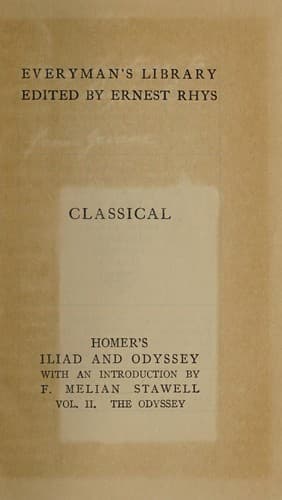
Epic poetry, Greek -- Translations into English; Homer -- Translations into English; Odysseus, King of Ithaca (Mythological character) -- Poetry
Postpone not this contention, but appoint
Forthwith the trial; for Ulysses here
Will sure arrive, ere they, (his polish'd bow
Long tamp'ring) shall prevail to stretch the nerve,
And speed the arrow through the iron rings.
To whom Penelope replied discrete. 730
Would'st thou with thy sweet converse, O my guest!
Here sooth me still, sleep ne'er should influence
These eyes the while; but always to resist
Sleep's pow'r is not for man, to whom the Gods
Each circumstance of his condition here
Fix universally. Myself will seek
My own apartment at the palace-top,
And there will lay me down on my sad couch,
For such it hath been, and with tears of mine
Ceaseless bedew'd, e'er since Ulysses went 740
To that bad city, never to be named.
There will I sleep; but sleep thou here below,
Either, thyself, preparing on the ground
Thy couch, or on a couch by these prepared.
So saying, she to her splendid chamber thence
Retired, not sole, but by her female train
Attended; there arrived, she wept her spouse,
Her lov'd Ulysses, till Minerva dropp'd
The balm of slumber on her weary lids.
FOOTNOTES:
[82] A gaberdine is a shaggy cloak of coarse but warm materials. Such
always make part of Homer's bed-furniture.
[83] Homer's morals seem to allow to a good man dissimulation, and even
an ambiguous oath, should they be necessary to save him from a villain.
Thus in Book XX. Telemachus swears by Zeus, that he does not hinder his
mother from marrying whom she pleases of the wooers, though at the same
time he is plotting their destruction with his father. F.
[84] In the Greek ὈΔΥΣΣΕΥΣ from the verb ὀδυσσω--Irascor, _I am angry_.
[85] She intended to slay the son of her husband's brother Amphion,
incited to it by the envy of his wife, who had six children, while
herself had only two, but through mistake she slew her own son Itylus,
and for her punishment was transformed by Jupiter into a nightingale.
[86] The difference of the two substances may perhaps serve to account
for the preference given in this case to the gate of horn; horn being
transparent, and as such emblematical of truth, while ivory, from its
whiteness, promises light, but is, in fact, opaque. F.
[87] The translation here is somewhat pleonastic for the sake of
perspicuity; the original is clear in itself, but not to us who have no
such practice. Twelve stakes were fixt in the earth, each having a ring
at the top; the order in which they stood was so exact, that an arrow
sent with an even hand through the first ring, would pass them all.
BOOK XX
ARGUMENT
Public-domain text, read in full here on John Shaqi.
Reviews
Reviews
No reviews yet
Be the first to share your thoughts on this work.
Elsewhere in the archive
Join the Discussion
Join the discussion
Sign in to leave a comment or review.
Sign InorCreate an account