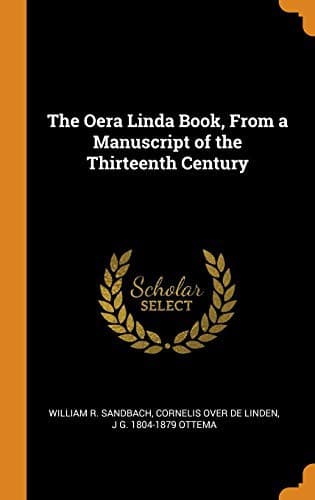
The Oera Linda Book, from a Manuscript of the Thirteenth Century
History
The Oera Linda Book, from a Manuscript of the Thirteenth Century
Frisian language -- Texts
and through us alone he can think, we proclaim everywhere where it
is necessary, We, Frya's children, exist through Wr-alda's life--in
the beginning mean and base, but always advancing towards perfection
without ever attaining the excellence of Wr-alda himself. Our spirit
is not Wr-alda's spirit, it is merely a shadow of it. When Wr-alda
created us, he lent us his wisdom, brains, organs, memory, and many
other good qualities. By this means we are able to contemplate his
creatures and his laws; by this means we can learn and can speak of
them always, and only for our own benefit. If Wr-alda had given us
no organs, we should have known nothing, and been more irrational
than a piece of sea-weed driven up and down by the ebb and flood.
THIS IS WRITTEN ON PARCHMENT--"SKRIVFILT." SPEECH AND ANSWER TO OTHER
MAIDENS AS AN EXAMPLE.
An unsociable, avaricious man came to complain to Troost, who was the
maid of Stavia. He said a thunderstorm had destroyed his house. He
had prayed to Wr-alda, but Wr-alda had given him no help. Are you
a true Frisian? Troost asked. From father and forefathers, replied
the man. Then she said, I will sow something in your conscience,
in confidence that it will take root, grow, and bear fruit. She
continued, When Frya was born, our mother stood naked and bare,
unprotected from the rays of the sun. She could ask no one, and
there was no one who could give her any help. Then Wr-alda wrought
in her conscience inclination and love, anxiety and fright. She
looked round her, and her inclination chose the best. She sought a
hiding-place under the sheltering lime-trees, but the rain came, and
the difficulty was that she got wet. She had seen how the water ran
down the pendent leaves; so she made a roof of leaves fastened with
sticks, but the wind blew the rain under it. She observed that the
stem would afford protection. She then built a wall of sods, first on
one side, and then all round. The wind grew stronger and blew away the
roof, but she made no complaint of Wr-alda. She made a roof of rushes,
and put stones upon it. Having found how hard it is to toil alone,
she showed her children how and why she had done it. They acted and
thought as she did. This is the way in which we became possessed
of houses and porches, a street, and lime-trees to protect us from
the rays of the sun. At last we have built a citadel, and all the
rest. If your house is not strong enough, then you must try and make
another. My house was strong enough, he said, but the flood and the
wind destroyed it. Where did your house stand? Troost asked. On the
bank of the Rhine, he answered. Did it not stand on a knoll? Troost
asked. No, said the man; my house stood alone on the bank. I built
it alone, but I could not alone make a hillock. I knew it, Troost
answered; the maidens told me. All your life you have avoided your
neighbours, fearing that you might have to give or do something for
them; but one cannot get on in the world in that way, for Wr-alda,
Public-domain text, read in full here on John Shaqi.
Reviews
Reviews
No reviews yet
Be the first to share your thoughts on this work.
Elsewhere in the archive
Join the Discussion
Join the discussion
Sign in to leave a comment or review.
Sign InorCreate an account