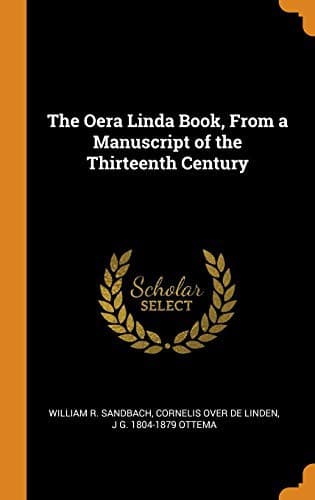
The Oera Linda Book, from a Manuscript of the Thirteenth Century
History
The Oera Linda Book, from a Manuscript of the Thirteenth Century
Frisian language -- Texts
Sixteen hundred years ago (she writes, 593 B.C.), Atland was submerged;
and at that time something happened which nobody had reckoned upon. In
the heart of Findasland, upon a mountain, lies a plain called Kasamyr
(Cashmere) that is "extraordinary." There was a child born whose mother
was the daughter of a king, and whose father was a high-priest. In
order to hide the shame they were obliged to renounce their own
blood. Therefore it was taken out of the town to poor people. As the
boy grew up, nothing was concealed from him, so he did all in his
power to acquire wisdom. His intellect was so great that he understood
everything that he saw or heard. The people regarded him with respect,
and the priests were afraid of his questions. When he was of full age
he went to his parents. They had to listen to some hard language;
and to get rid of him they gave him a quantity of jewels, but they
dared not openly acknowledge him. Overcome with sorrow at the false
shame of his parents, he wandered about. While travelling he fell in
with a Frisian sailor who was serving as a slave, and who taught him
our manners and customs. He bought the freedom of the slave, and they
remained friends till death. Wherever he went he taught the people not
to tolerate rich men or priests, and that they must guard themselves
against false shame, which everywhere did harm to love and charity. The
earth, he said, bestowed her treasures on those who scratch her skin;
so all are obliged to dig, and plough, and sow if they wish to reap,
but no one is obliged to do anything for another unless it be out of
goodwill. He taught that men should not seek in her bowels for gold,
or silver, or precious stones, which occasion envy and destroy love. To
embellish your wives and daughters, he said, the river offers her pure
stream. No man is able to make everybody equally rich and happy, but
it is the duty of all men to make each other as equally rich and as
happy as possible. Men should not despise any knowledge; but justice
is the greatest knowledge that time can teach, because she wards off
offences and promotes love.
His first name was Jessos, but the priests, who hated him, called him
Fo, that is, false; the people called him Krishna, that is, shepherd;
and his Frisian friend called him Buddha (purse), because he had in
his head a treasure of wisdom, and in his heart a treasure of love.
At last he was obliged to flee from the wrath of the priests; but
wherever he went his teaching had preceded him, whilst his enemies
followed him like his shadow. When Jessos had thus travelled for
twelve years he died; but his friends preserved his teaching, and
spread it wherever they found listeners.
Public-domain text, read in full here on John Shaqi.
Reviews
Reviews
No reviews yet
Be the first to share your thoughts on this work.
Elsewhere in the archive
Join the Discussion
Join the discussion
Sign in to leave a comment or review.
Sign InorCreate an account