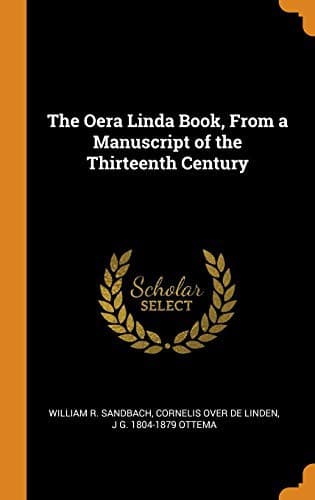
The Oera Linda Book, from a Manuscript of the Thirteenth Century
History
The Oera Linda Book, from a Manuscript of the Thirteenth Century
Frisian language -- Texts
therefore I will first write about black Adel. Black Adel was the
fourth king after Friso. In his youth he studied first at Texland, and
then at Staveren, and afterwards travelled through all the states. When
he was twenty-four years old his father had him elected Asega-Asker. As
soon as he became Asker he always took the part of the poor. The rich,
he said, do enough of wrong by means of their wealth, therefore we
ought to take care that the poor look up to us. By arguments of this
kind he became the friend of the poor and the terror of the rich. It
was carried so far that his father looked up to him. When his father
died he succeeded, and then he wished to retain his office as well,
as the kings of the East used to do. The rich would not suffer this,
so all the people rose up, and the rich were glad to get out of the
assembly with whole skins. From that time there was no more talk of
equality. He oppressed the rich and flattered the poor, by whose
assistance he succeeded in all his wishes. King Askar, as he was
always called, was seven feet high, and his strength was as remarkable
as his height. He had a clear intellect, so that he understood all
that was talked about, but in his actions he did not display much
wisdom. He had a handsome countenance and a smooth tongue, but his
soul was blacker than his hair. When he had been king for a year,
he obliged all the young men in the state to come once a year to the
camp to have a sham fight. At first he had some trouble with it, but
at last it became such a habit that old and young came from all sides
to ask if they might take part in it. When he had brought it to this
point, he established military schools. The rich complained that their
children no longer learned to read and write. Askar paid no attention
to it; but shortly afterwards, when a sham fight was held, he mounted
a throne and spoke aloud: The rich have come to complain to me that
their boys do not learn to read and write. I answered nothing; but I
will now declare my opinion, and let the general assembly decide. While
they all regarded him with curiosity, he said further: According to my
idea, we ought to leave reading and writing at present to the maagden
and wise people. I do not wish to speak ill of our forefathers; I
will only say that in the times so vaunted by some, the Burgtmaagden
introduced disputes into our country, which the mothers were unable,
either first or last, to put an end to. Worse still, while they talked
and chattered about useless customs the Gauls came and seized all our
beautiful southern country. Even at this very time our degenerate
brothers and their soldiers have already come over the Scheldt. It
therefore remains for us to choose whether we will carry a yoke or
a sword. If we wish to be and to remain free, it behoves our young
men to leave reading and writing alone for a time; and instead of
playing games of swinging and wrestling, they must learn to play with
sword and spear.
Public-domain text, read in full here on John Shaqi.
Reviews
Reviews
No reviews yet
Be the first to share your thoughts on this work.
Elsewhere in the archive
Join the Discussion
Join the discussion
Sign in to leave a comment or review.
Sign InorCreate an account