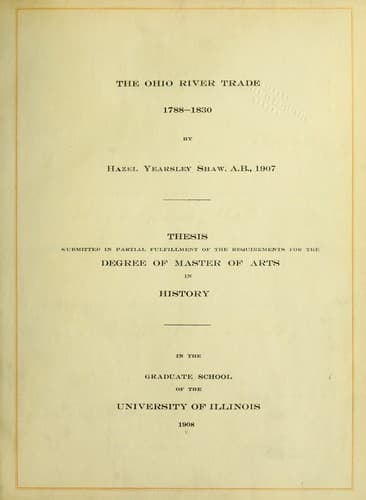
The Ohio River Trade, 1788-1830Shaw, Hazel Yearsley
History
The Ohio River Trade, 1788-1830
Shaw, Hazel Yearsley
Ohio River -- History; Ohio River Valley -- History
Horses, hogs, and cattle were raised, in Illinois, for
exportation.[432] Flour, and fish were exported from Cincinnati to
New Orleans, in the year 1818.[433] Birckbeck, in 1818, writes as
follows, "The demand for grain will probably equal the produce
for some years, owing to the influx of new settlers; and the
Southern States, down the Mississippi to New Orleans, will be an
increasing and sure market for our surplus of every kind; vast
quantities of pork, and beef are shipped for New Orleans from
Kentucky and Indiana."[434] "500 persons every summer pass down
the Ohio from Cincinnati to New Orleans as traders or boatmen,
and return on foot. By water, the distance is 1700 miles, and
the walk back 1000. Many go down to New Orleans from Pittsburg,
which adds 500 miles to the distance by water, and 300 by land.
The storekeepers of these western towns, visit the eastern ports
of Baltimore, Philadelphia, and New York, once a year, to lay
in their stock of goods. The great variety of articles, and the
risk attending their carriage to so great a distance, by land and
water, renders it necessary that the storekeepers should attend
both to their purchase and conveyance. I think the time is at hand
when these periodical transmontane journeys are to give place to
expeditions down the Ohio and Mississippi to New Orleans. The vast
and increasing produce of these states, in grain, flour, cotton,
sugar, tobacco, peltry, timber, etc., which finds a ready vent
at New Orleans, will be returned through the same channel in the
manufactures of Europe, and the luxuries of the East to supply the
growing demands of this western world."[435]
Faux, while traveling in America, was told by Eastern farmers that
transportation per barrel for 80 miles cost half a dollar, while
the farmers of the West could send it 2000 miles for $6;[436] and
that the western people could afford to sell at half price, better
than the eastern could at whole price, because they grew double
the quantity per acre, and because the popula tion was rapidly
increasing.[437]
Great supplies of lumber from the extensive pine forests about
the sources of the Allegheny, supplied the country below as far
as New Orleans.[438] A yankee speculation to New Orleans sometimes
consisted "of iron coffins, or nests of coffins filled with shoes,
so accomodating both the living and the dead."[439]
Wheat in Ohio, in 1819-1820, even at 50 cents, found no market,
as New Orleans was then supplied by countries more conveniently
situated.[440] Boats carrying from 100 to 500 barrels, sold for
only $16.[441] Cincinnati continued to send flour and pork to New
Orleans.[442] Flint says, "On shore the utmost bustle prevails, with
drays carrying imported goods, salt, iron, and timber, up to the
town, and in bringing down pork, flour, etc., to be put aboard
boats for New Orleans."[443]
Public-domain text, read in full here on John Shaqi.
Reviews
Reviews
No reviews yet
Be the first to share your thoughts on this work.
Elsewhere in the archive
Join the Discussion
Join the discussion
Sign in to leave a comment or review.
Sign InorCreate an account