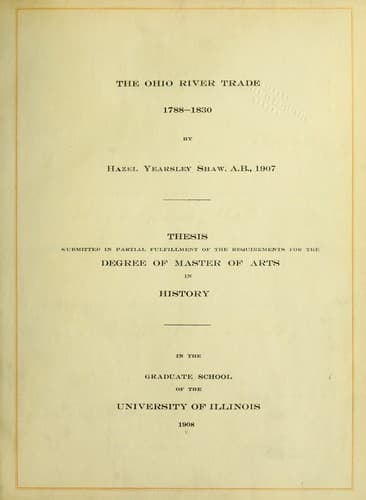
The Ohio River Trade, 1788-1830Shaw, Hazel Yearsley
History
The Ohio River Trade, 1788-1830
Shaw, Hazel Yearsley
Ohio River -- History; Ohio River Valley -- History
Produce was floated down the Wabash, and the boats returned laden
with goods for their market at an enormous profit.[444] Indian corn
was purchased of the farmer on the Wabash at 25 cents per bushel,
soon after harvest; in the spring it was sent to New Orleans under
a freight of 25 cents per bushel, and sold at 75 cents to one
dollar a bushel; wheat was bought at six pence or seven pence the
bushel dearer than corn, and sold proportionally higher.[445] Produce
from the English settlement in Illinois, (corn, etc,), was hauled
to Bon Pas, which was on a tributary of the Wabash, and sent from
thence to New Orleans, there to be shipped either for Europe or the
eastern ports of America.[446]
For a return lading salt was purchased at half a dollar per bushel,
and sold at Vincennes from $2 to $2¼ per bushel. Loaf sugar sold at
50 cents per pound; brown sugar at 37½ cents per pound; coffee at
75 cents per pound; tea from $2½ to $3½; and many other groceries,
which like the above were bought for considerably less than one
half their selling price.[447] Welby says, "... of iron and drugs
I could not obtain the price at New Orleans; but of the profit on
the iron the reader may judge by the price I paid to a blacksmith
for eight new horse shoes, steel tacs, and eight removes, the bill
for which was about $10."[448] Faux, speaking of a man who had come
to Princeton, says, "If he had money he could buy bacon at $4 and
sell it at $16; and sugar from New Orleans would pay 50 per cent;
costing 10 cents, and selling at 25 cents, 2½ cents being deducted
per pound for carriage. Store goods, bought at Washington, which he
is selling cheaper than his neighbors, pay 25 per cent profit."[449]
Cincinnati received cotton from northern Alabama.[450]
The 'Register' of June 9, 1821, says, "The whole number of boats
which passed the Falls of Ohio last year, is estimated to be
2400, wafting the rich produce of the western world to the markets
on the seaboard, the principal part of which consisted of 1,804,810
pounds of bacon, 200,000 barrels of flour, 20,000 barrels of pork,
62,000 bushels of oats, 100,000 bushels of corn, 10,000 barrels of
cheese, 160,000 pounds of butter, 11,207,333 fowls, and 466,412
pounds of lard."[451]
Stove coal was carried in boats down the river in 1821-1823 to
supply the great number of steam mills in making flour.[452] These
boats were also engaged in freighting salt to the various parts
of the count ry.[453] The following is an "estimate of the amount
of products which descended the Falls of Ohio at Louisville, the
growth of the year 1822 ... the produce of the whole of the State
of Ohio, (except the part bordering on the lake), two-thirds of
Kentucky, one half of the State of Indiana, and a small part of the
States of Pennsylvania and Virginia."[454]
Notice the vast increase since 1820.
_Est. Tons._ _Est. Cost._
Public-domain text, read in full here on John Shaqi.
Reviews
Reviews
No reviews yet
Be the first to share your thoughts on this work.
Elsewhere in the archive
Join the Discussion
Join the discussion
Sign in to leave a comment or review.
Sign InorCreate an account