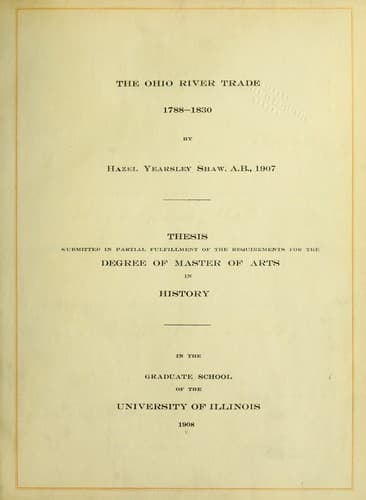
The Ohio River Trade, 1788-1830Shaw, Hazel Yearsley
History
The Ohio River Trade, 1788-1830
Shaw, Hazel Yearsley
Ohio River -- History; Ohio River Valley -- History
Corn and wheat were sent to New Orleans from Illinois in 1823.[455]
Albion, Illinois, exported produce, for the first time, in this
year. They loaded the flat boats with corn, flour, pork, beef,
sausages, and other articles, and floated them down the Wabash
into the Ohio, and from thence to New Orleans.[456] Harmony was,
annually, sending boats laden with produce to New Orleans.[457]
Tranchepain journeyed part of the way down the Ohio in a boat
loaded with horses, fowls, iron castings, apples, and whiskey for
New Orleans.[458]
From St. Louis, a central point on the Mississippi, to New York
by way of New Orleans, the price of transportation was about $45
per ton, for a return cargo not less than $80.[459] Beck says, "The
export trade must then be divided between New Orleans and New
York. She (New Orleans) commands the greatest interior; she is
the key to the richest and most extensive inland region of any
mercantile capital in the world. Besides the produce required for
her own consumption, and that of Louisiana and Mississippi, she
will be the entrepot of the produce destined for the West Indies
and the provinces of South America. The capital of New Orleans
is disproportionate to the quantity of produce landed there. The
warmth and unhealthiness of the climate prevents the farmer from
sending his produce to that place at a time when he may be most in
need of the articles for which he would barter. During this time,
he is at present completely deprived of a market for his produce,
and is moreover obliged to pay the merchant an exorbitant price
for his necessaries. It frequently happens, that in the Western
States during the summer and fall, the price of those articles for
which they depend upon New Orleans is raised 50 and sometimes 100%.
But New Orleans is at all times a very uncertain market. It not
unfrequently happens that a few boat loads of produce completely
supply the demand.[460] If another cargo then arrives the owner is
obliged either to sacrifice it, or leave it in store; in the latter
case, if it consists of flour of bacon, it suffers much from the
heat and humidity of the climate, and its value is not unfrequently
diminished one half or three fourths. This is also the case with
furs and several other articles which cannot be transported by New
Orleans to a foreign market, without a considerable depreciation in
their value. These considerations clearly prove the importance of
opening a communication with New York, by which means the States
bordering on the Mississippi will be enabled to find a market
for their produce during those seasons when they are completely
excluded from New Orleans. Even at this time merchants at St.
Louis, and in different parts of Illinois and Missouri purchase
their goods in the eastern cities, and transport them across the
mountains in preference to sending them by New Orleans."[461] For
several years all articles of life in Illinois and Missouri, were
Public-domain text, read in full here on John Shaqi.
Reviews
Reviews
No reviews yet
Be the first to share your thoughts on this work.
Elsewhere in the archive
Join the Discussion
Join the discussion
Sign in to leave a comment or review.
Sign InorCreate an account