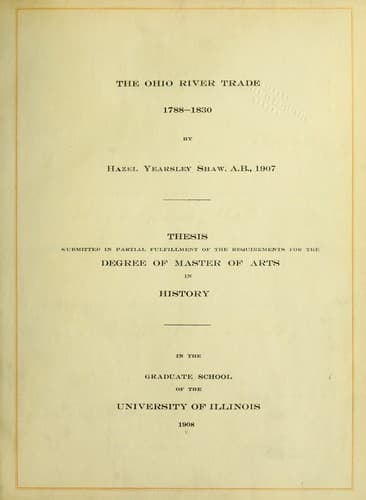
The Ohio River Trade, 1788-1830Shaw, Hazel Yearsley
History
The Ohio River Trade, 1788-1830
Shaw, Hazel Yearsley
Ohio River -- History; Ohio River Valley -- History
to the price of provisions, and very expensive considering the
accommodations afforded; storekeepers laying on a profit of at
least 50 per cent.[509] Fordham says that the passage by stage and
the expense of a journey from Philadelphia to Pittsburg was $50;
the journey down the Ohio 900 miles from $10 to $15; to St. Louis
by steamboat $20, on horseback $8.[510]
The route to the western country, by way of New Orleans, was
attended with many disadvantages, being much longer and more
dangerous, in consequence of a good deal of coasting, and the
difficulties of the Gulf of Florida. The voyage from the Balize
to New Orleans, a distance of 100 miles, was always tedious and
vessels sometimes consumed three weeks in covering this distance.
The steamboats, from New Orleans,[511] did not proceed at stated
periods, and travelers were sometimes obliged to take up a long and
expensive residence in that city. To attempt to engage a passage
in a keel boat up the stream was an almost endless undertaking.
For these reasons, emigrants were advised to cone overland to
Pittsburg, and to float from there down the Ohio River to their
destination.[512]
Fearon during his journey from Chambersburg to Pittsburg passed 63
wagons, with families from the several places following: 20 from
Massachusetts, 10 from the district of Maine, 14 from Jersey, 13
from Connecticut, 2 from Maryland, 1 from Pennsylvania, 1 from
England, one from Holland, 1 from Ireland; and about 200 persons on
horseback and 20 on foot.[513] Fearon says that every emigrant whom
he met on the Alleghanies, told hi m that he intended to settle
in Ohio.[514] The population in Illinois, at this period, was to be
found chiefly on the Wabash, below Vincennes, and on the banks of
the Kaskaskia, Ohio, and Mississippi Rivers.[515]
Public-domain text, read in full here on John Shaqi.
Reviews
Reviews
No reviews yet
Be the first to share your thoughts on this work.
Elsewhere in the archive
Join the Discussion
Join the discussion
Sign in to leave a comment or review.
Sign InorCreate an account