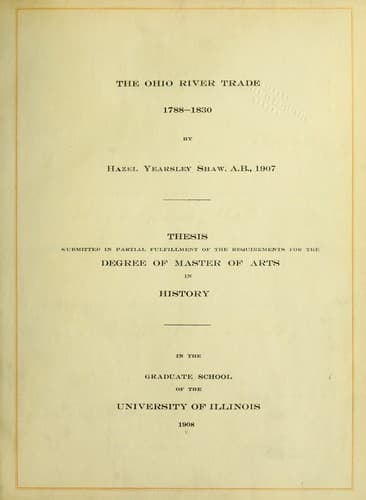
The Ohio River Trade, 1788-1830Shaw, Hazel Yearsley
History
The Ohio River Trade, 1788-1830
Shaw, Hazel Yearsley
Ohio River -- History; Ohio River Valley -- History
Travelers coming from the Atlantic States, with the intention of
descending the Ohio and going into the western states, preferred
the National Road to the one which came from Philadelphia to
Pittsburg, and was made by the State of Pennsylvania. The traffic
of the Pennsylvania "turnpike" was therefore much diminished, and
the people of that State, as well as many of the other states, who
derived no immediate benefit from this road, were opposed to any
grants being made by Congress for keeping it in order.[527]
The conveyance of goods from the eastern ports to Pittsburg, to be
sent from that place to the western country, created much business
and contributed to the rapid growth of the city. In the year 1813,
no less than 4055 wagons engaged in this trade, were calculated to
have reached Pittsburg.[528] During the eight months from April to
December, 1815, no less than $356,000 were paid at Pittsburg alone
for the carriage of goods brought to and unladen at that town, by
wagons, from the seaports of the Atlantic. The value of the goods
so brought was supposed to be three and a half to four million
dollars.[529] During the year 1817, about 12,000 wagons passed
between Baltimore and Philadelphia, carrying from 35 to 40 cwt. The
cost of carriage was about $7 from Philadelphia to Pittsburg, and
the money paid for the conveyance of goods on this road, exceeded
300,000 pounds sterling.[530] Fearon says, "The articles sent from
Philadelphia are hardware, and what are denominated "dry goods"
This term includes all articles of woolen, linen, cotton, and
silk. Those returned from Pittsburg are farming produce, chiefly
flour."[531]
For the next few years the trade of Pittsburg failed to increase
so rapidly as formerly. The tradesmen, though living well and
saving money, complained of hard times, saying that peace had
thrown the ocean trade into New Orleans, which they in time of war
monopolized.[532] Pittsburg also suffered on account of the enormous
influx of British goods, which were imported for the purpose ob
breaking down the new manufacturing establishments.[533] Wheeling,
being better situated for ready communication with the western
country, at all seasons began to draw away some of the trade of
Pittsburg.[534]
About the year 1818 the States of New York and Virginia began to
show themselves as the rivals of Pennsylvania, which till that
time, with the exception of New Orleans had enjoyed the most
considerable portion of the commerce of the west.[535]
Public-domain text, read in full here on John Shaqi.
Reviews
Reviews
No reviews yet
Be the first to share your thoughts on this work.
Elsewhere in the archive
Join the Discussion
Join the discussion
Sign in to leave a comment or review.
Sign InorCreate an account