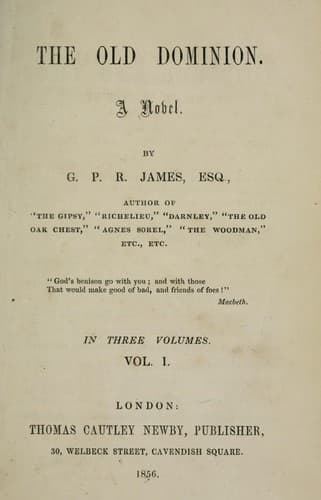
The Old DominionJames, G. P. R. (George Payne Rainsford)
General
The Old Dominion
James, G. P. R. (George Payne Rainsford)
Southampton Insurrection, 1831 -- Fiction
We Englishmen are not very fond of warm professions, for we rarely
make them ourselves, and have no allowance for different customs,
blood, and temper. Yet the girl's face looked frank and open; and I
invited her to sit down beside us, wishing to extract any information
she might possess.
It was not much that she could give; for, as I think I have elsewhere
remarked, there is not a perfect sympathy between the mulatto and the
black race. The former are inclined to be somewhat conceited upon
their approximation to their masters; the latter view the mulattoes
with a certain degree of contempt and dislike as inheriting a portion
of the blood of the slave-holder, without his power or intellect. They
often intermarry, it is true; still this latent sort of aversion
prevails; and you will always hear the negroes speak of the yellow man
or the yellow woman with a cold and slighting tone.
On the present occasion, it would seem, many of the mulattoes
entertained some apprehension that the vengeance of the negroes would
be extended to them on account of the white blood in their veins. This
was especially the case amongst the mulatto women; and Minerva told
us, she had only ventured to hold communication with some of the
people of her own colour. From them she had learned that from thirty
to forty white persons had been slaughtered during the preceding
night; that being attacked totally unprepared, no resistance had been
offered, and that the negroes in the morning, in considerable numbers
(swelled doubtlessly by her imagination), and armed and mounted, had
marched upon Jerusalem, intending to sack and burn the town. They had
been met upon the road, however, at the distance of about a mile from
where we then were, by a body of armed white men, who had fired upon
and dispersed them.
But she added, what was very important in our eyes, that they had
since reassembled in greater force than ever, and had murdered a party
of four white people whom they had met upon the road.
She could not give us any of the particulars, for she had only heard
them from a mulatto man, who had heard them from somebody else. We
must all have had cause to know--sometimes to our cost--how dangerous
it is to rely upon current rumours in times of peril and excitement.
It seemed to me, too, that the girl was inclined to shirk some of my
questions. I asked Bessy, therefore, in Italian, which she spoke very
well, if the woman was to be relied upon.
"Oh, yes," she answered; "I have always heard her spoken of as a very
good, honest girl, although, doubtless, she, like all the negroes, is
inclined to magnify whatever she hears."
"Were the white men who you say were killed upon the road armed?" I
asked, turning to the girl.
"Yes, that they were," she said; "for the gentleman told me there was
a terrible fight. But all the white men were killed, nevertheless; de
niggers were too many for them."
"Can you tell which way the black men went after that?" I inquired.
Public-domain text, read in full here on John Shaqi.
Reviews
Reviews
No reviews yet
Be the first to share your thoughts on this work.
Elsewhere in the archive
Join the Discussion
Join the discussion
Sign in to leave a comment or review.
Sign InorCreate an account