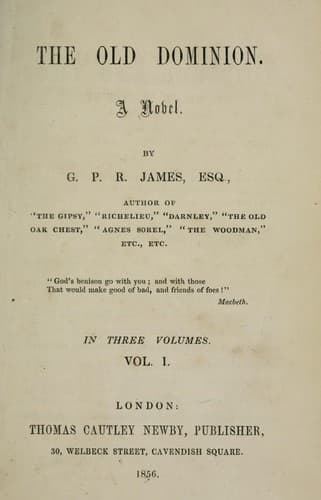
The Old DominionJames, G. P. R. (George Payne Rainsford)
General
The Old Dominion
James, G. P. R. (George Payne Rainsford)
Southampton Insurrection, 1831 -- Fiction
I need not say that all my thoughts were of Bessy Davenport. They were
very anxious, very gloomy, very bitter. I blamed myself for having
left her at all. I thought that if she had met with danger or death, I
should never forgive myself. No language which I can find will convey
any idea of the sensations I experienced--the internal shudder, as it
were, the wringing of the very heart of my spirit, when my mind
rested, even for a moment, on her possible, nay, her probable fate. It
was in vain I tried to console myself by trying to think I had acted
for the best. The homely but true and startling words of Billy Byles
came back to my mind,--"D----n the best; it is always the worst thing
a man can do;" and I was ready to pile curses upon my own head for
having abandoned, even for a moment, the task of protecting the dear
girl, with which Heaven seemed to have charged me.
Censure on myself, however, made me feel inclined to be more lenient
to others. Poor Zed, though I could not help feeling some bitterness
still, had only done, according to his views and capacity, what I had
done myself. He had acted for the best; and, softening towards him, I
called him up to my side; for hitherto he had ridden two or three
horse-lengths behind me.
"Tell me, Zed," I said, "and now, mind you tell me the truth, for I
will forgive anything rather than falsehood."
"I will tell the truth if I can, master," answered Zed; "but
sometimes, when I'm in a hurry, I can't tell de truth. The lies come
so thick and fast, they get all the uppermost, and I have no time to
put them down, and get the truth up from de bottom of de well, as men
say."
"Well then, take time and do not hurry," I answered. "You say you saw
Colonel Halliday in the wood. Was that true?"
"Oh, yes, indeed, master," he answered; "I saw him there, and six or
seven men with him."
"Was he on horseback or on foot?" I asked.
"He had been on horseback," replied Zed; "but he left his horses in de
path, and went in on foot, just where the two roads meet. I heard him
swear he saw a large smoke, and he would know what it was. I did not
let him see me, for he is a wild man, and was just as like to cut me
and uncle Jack down as not, because we had black skins."
"Then he went right on towards the smoke?" I demanded.
"Yes, that he did," replied the man; "and he must have gone some way
down, for his voice sounded quite small when he came out upon the road
again, and he hallooed to the people to bring him down the horses."
"Then he did not find any of the negroes?" I asked.
"No, how could he?" answered Zed; "for they did not come up till he
was gone. They saw him, I guess, and scattered to keep out of his way.
But he came first, that's certain. I can't tell quite sure where he
went, for I did not see him go; but he could not have been gone long
before you came up."
Public-domain text, read in full here on John Shaqi.
Reviews
Reviews
No reviews yet
Be the first to share your thoughts on this work.
Elsewhere in the archive
Join the Discussion
Join the discussion
Sign in to leave a comment or review.
Sign InorCreate an account