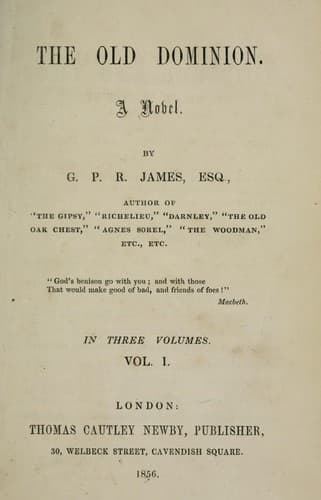
The Old DominionJames, G. P. R. (George Payne Rainsford)
General
The Old Dominion
James, G. P. R. (George Payne Rainsford)
Southampton Insurrection, 1831 -- Fiction
"I will show you, gentlemen: they are at what we call the old
quarters, two miles off, just upon the edge of the Swamp. Mr. ----
thought it would be better to place them there, as the cabins are
comfortable and were vacant; and no one could get at them to steal
them without crossing the plantation. I have put them," he added, "to
a little task-work, just to give them something to do. But a regular
account is kept of what they earn, which will be given in, when the
courts decide to whom they belong."
He looked at me as he spoke, as if understanding fully that I was one
of the claimants; and I thought I recognized his face as one of those
who had been with the party who pursued the kidnappers of these poor
people, as far almost as the frontier of North Carolina.
"I suppose the negroes are very well content," I replied, "to remain
here, and not go to New Orleans."
"That they are," answered the man, "and very much obliged to you, sir,
for stopping them just when you did. I believe one-half of them would
have died, if they had taken them away. They were born here and bred
here, and have all been very happy here; and you'll find very few that
like to quit Virginia, go where they may."
I could not but smile at the man's patriotism; though, to say the
truth, I did not much doubt he was right; for, as far as I had ever
seen then, and have ever seen since, the existence of slavery--great
as the evil is in every form--is so mitigated in that state, that I
doubt not the slaves themselves would "rather bear the ills they have,
than fly to others that they know not of."
"Pray," I asked, as we rode on, "when speaking of task-work, what do
you consider as a fair day's task here?"
"That depends upon the nature of the work, sir," he answered. "But I
can show you, as we go along, what we should consider a fair day's
task in several different kinds of field labour."
He did so; and I found that it was rather less than one-half of what
an English labourer could perform easily in a day.
"Do you mean to say," I inquired, "that one of your hands cannot get
through more than that in a day?"
"Oh dear, no, sir," he replied. "They can do twice as much in ordinary
weather. Sometimes, it is dreadful hot to be sure; and then they can't
do as much; but generally they have a good many hours to do what they
like about their own place, if they are industrious--if not, to be
still and sleep, as some of them do. Task-work, I think, is the best
plan for them; the master is sure to get his work done; and, just as
the hand is active and willing, he gets the advantage of it, which is
an encouragement."
Public-domain text, read in full here on John Shaqi.
Reviews
Reviews
No reviews yet
Be the first to share your thoughts on this work.
Elsewhere in the archive
Join the Discussion
Join the discussion
Sign in to leave a comment or review.
Sign InorCreate an account