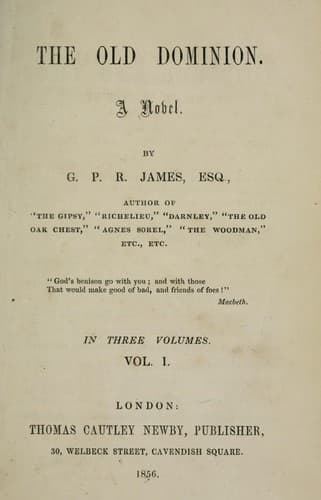
The Old DominionJames, G. P. R. (George Payne Rainsford)
General
The Old Dominion
James, G. P. R. (George Payne Rainsford)
Southampton Insurrection, 1831 -- Fiction
"Oh, no secret at all," replied my Norfolk friend. "One of those
matters of business which occur every day--a gentleman, who owes to me
and my Boston partners certain banks of ducats, as that funny old
fellow, Shakspeare, would call them, which he neglected to pay; he
promised them the day before yesterday morning, on the nail, in the
city of Portsmouth, at the hour of the arrival of the stage; but
neither he nor the dollars ever appeared. I had warned him that this
was the last time--it was about the fiftieth--that he should break his
promise, and I pointed out to him that though habits of intimacy and
some kindness shown to me, a long time ago, when he was a man of about
forty, and I a youth of twenty-two or twenty-three, had induced me to
forbear, notwithstanding the after-conduct which had severed our
friendship; yet, as there were other persons concerned, who had
befriended him, at my request, I was now bound to see them paid."
"But who is he--who is he?" asked the sheriff.
"Oh, your neighbour, Mr. William Thornton," replied Mr. Wheatley. "He
told me he was to receive thirty thousand dollars this week, and would
pay them over immediately; but he was like Hope, that told the
flattering tale, which turned out untrue."
"He has had his hands somewhat too full of business lately," replied
the sheriff gravely.
"Yes, my dear sir," answered Mr. Wheatley. "I dare say there has been
a little bustle in the country; but I cannot allow the sports and
pastimes of a number of coloured gentlemen to interfere with regular
commercial transactions."
"You are not aware, my good friend," replied the sheriff, "that this
unfortunate gentleman was, himself, severely wounded yesterday, and
his son shot dead on the spot, by some of the revolted negroes. These
are the latest victims of Nat Turner's insurrection. I trust they will
also be the last."
Mr. Wheatley looked aghast.
"Poor devil!" he exclaimed. "Of his son I know nothing; but of himself
I saw very much in my young days, when this Robert was a boy."
"I trust, under the circumstances, Mr. Wheatley," said the sheriff,
"that you will not judge it right to disturb this unfortunate man on
his death-bed."
"I must see that the property is some way adequately secured," said
Mr. Wheatley, gravely, after a moment's thought. "For myself, I should
not care, sheriff. I could make up my mind to lose the fifteen
thousand dollars, which is my share of the business; but there is
another gentleman concerned, who never knew him, and is greatly
irritated at his conduct."
"He has been very unfortunate, you know," urged the sheriff.
"Nay, sir, nay," replied Mr. Wheatley, drawing himself up with a
sterner look than I ever thought his face could assume. "Unfortunate,
truly, in being destitute alike of principle, and honour, and
generosity; but in nothing else. The base and scandalous transaction
which broke off my intimacy with him was the beginning of what you
call his misfortunes."
Public-domain text, read in full here on John Shaqi.
Reviews
Reviews
No reviews yet
Be the first to share your thoughts on this work.
Elsewhere in the archive
Join the Discussion
Join the discussion
Sign in to leave a comment or review.
Sign InorCreate an account