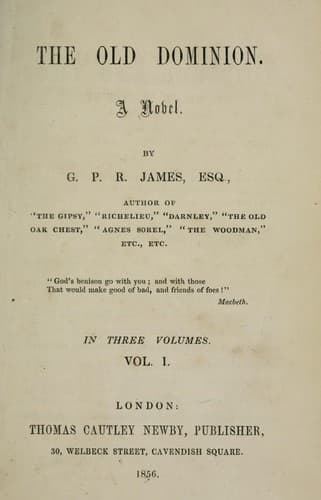
The Old DominionJames, G. P. R. (George Payne Rainsford)
General
The Old Dominion
James, G. P. R. (George Payne Rainsford)
Southampton Insurrection, 1831 -- Fiction
Such seemed the case with me. I determined to know all, if it could be
known--I determined that there should be no dark and cloudy spot, no
storm upon the edge of the sky, the course and nature of which I did
not know; and, although the future, the dark predestined future, no
man can truly divine--the past, upon which the seal of destiny was
set, the true, irrevocable past, might well be scanned, till the real
gold of truth should be separated from the dross of doubt and
falsehood.
"We want much," I said, addressing the old negro, "to see Mr. William
Thornton upon business of great importance--business which has even
reference to the hour of death, and which must not be postponed.
Indeed, this gentleman _must_ see Mr. Thornton in order to spare him
greater discomfort at this sad and perilous moment. I may have more
personal views; but at the same time, my good friend, I cannot help
thinking that he who parts from this world with a free confession of
his errors in it, and some expression of regret, sets forth for the
wide future with more comfort and more hope."
"Assuredly," replied the negro; "and I will try to bring him to
receive you as tranquilly and as willingly as may be. But I cannot
answer for success; perhaps he may refuse--perhaps you may have to
force your way to him whether he desires it or not, as I had last
night; but at all events, I will do my best. Wait here, and I will
return to you presently. He was somewhat drowsy when I left him; and I
was glad to give him a little repose; for the words which I had read
to him from the Great Teacher had tortured him like the first effect
of a strong medicine for the cure of a terrible disease."
The old man paused; and, after a moment or two of silent thought, went
back into the house, telling some of his dark brethren to take care of
our horses. We followed him into one of the lower rooms; and the
contrast was certainly very sad between the aspect of his dwelling and
that of his cousin Mr. Henry Thornton. They had set out in life very
nearly equal in fortune--perhaps, of the two, William Thornton was the
more wealthy; yet the one had surrounded himself with family ties: had
lived in comfort, if not in splendour, had done right and justice to
all men; had preserved a high and unspotted name; and, in moderation,
had continued in peace and competence. Probably his household
presented no difference from the state in which it existed twenty
years before; he had sought for nothing higher, he had fallen no
lower.
Public-domain text, read in full here on John Shaqi.
Reviews
Reviews
No reviews yet
Be the first to share your thoughts on this work.
Elsewhere in the archive
Join the Discussion
Join the discussion
Sign in to leave a comment or review.
Sign InorCreate an account