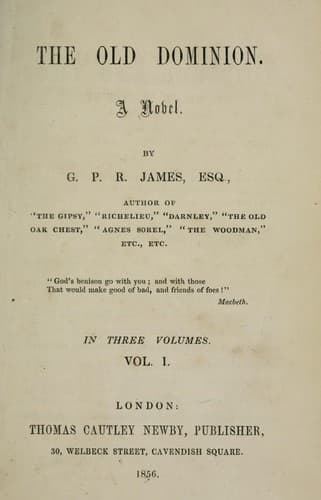
The Old DominionJames, G. P. R. (George Payne Rainsford)
General
The Old Dominion
James, G. P. R. (George Payne Rainsford)
Southampton Insurrection, 1831 -- Fiction
"No bad plan," said the sheriff, with a nod of his head; "but, will
you have force enough?"
"I understand they have got several fellows with them--three Irishmen
and a Dutchman, besides others."
"Give me two other stout men besides Mr. Byles," said I, "and I will
undertake to keep them at a stand till you come up."
"A soldier?" asked the sheriff, laconically.
I nodded my head.
"Well, go along then," he said; "there's your way up there; then the
first to the right; but then mind the jog of the road to the left,
about seven miles on. But Byles knows all about it; he knows the
country right well. Here's their trail--these waggon ruts, freshly
made and sharp at the edges. You can easily judge by these whether
they have gone on; and if they have got beyond the camp, you had
better stay there till we come. There will be nothing for it then but
to ride them straight down as hard as we can go."
The matter was soon explained to Mr. Byles, who was ready for
anything; and after he, on his best judgment, had selected two stout
fellows to accompany us, we set off at as fast a pace as we could well
go, till we reached the month of the very narrow path which we had to
pursue. Nor did we much slacken our speed there; although, to say the
truth, it was rather a perilous undertaking to ride along it with such
velocity; for the boughs swung across in many directions, whisking
one's eyes, or one's knees, or one's head, every two or three hundred
yards.
"Now we are coming near the bad place by the bar," said Billy Byles.
"Keep a short rein and ease them up as you go through."
And on he went, into what seemed to me neither more nor less than a
morass. His horse made a terrible flounder at the first plunge, but
was up again in a moment; and on we all went, stumbling, and sinking,
and rolling, but scrambling on still, till we reached the other side
of the _bad place_, and were once more upon firm ground.
The next three or four miles were much more open, the road passing
through a low sort of brushwood, with scattered scrubby trees, and a
good deal of short grass between. We took advantage of it to the
uttermost, and entered the thicker wood again after a gallop of some
twenty minutes.
"I think we must have distanced them," said Billy Byles, slackening
his speed a little; "the waggons cannot go more than three miles an
hour at their very best, and we have not let the grass grow under us."
On we went, however, at a very quick trot; and, at the end of three
miles further, Mr. Byles said in a low tone,--
"We are coming near now. We shall soon know what we are about."
At the same moment, I heard a sound, proceeding, apparently, from some
spot not more than a couple of hundred yards on our left. It was a low
sort of whining, complaining noise, something like a door turning on
rusty hinges; and I said,--
"Hark! what is that?"
"An ungreased waggon wheel," replied Billy Byles. "We have caught
them, for a hundred dollars."
Public-domain text, read in full here on John Shaqi.
Reviews
Reviews
No reviews yet
Be the first to share your thoughts on this work.
Elsewhere in the archive
Join the Discussion
Join the discussion
Sign in to leave a comment or review.
Sign InorCreate an account