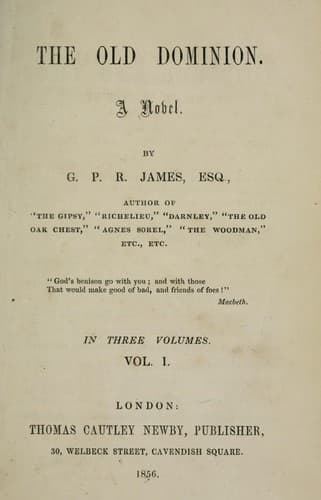
The Old DominionJames, G. P. R. (George Payne Rainsford)
General
The Old Dominion
James, G. P. R. (George Payne Rainsford)
Southampton Insurrection, 1831 -- Fiction
Just then appeared Bessy Davenport, and he stopped short; but I
answered at once, as if he had concluded his sentence, "With a great
deal of pleasure; at what hour do you dine?"
"Oh, at three, at three," answered Billy Byles. "I have not got into
these people's bad habits yet."
"Indeed!" cried Bessy coming up. "I did not know that you ever let any
bad habit pass you, Mr. Byles, without trying it on at least."
"You are a wicked little satirist, Miss Bessy," he answered; "but I
know the cause of your malice: you are angry at my taking Sir Richard
away from you to dine with me on Friday."
"If you don't do any worse with him than that, I don't care," said
Bessy; "but I doubt you both, I tell you. Come, cousin Richard, let us
go, or we shall have a warm walk back."
And leaving Mr. Byles, we walked on towards the edge of the forest.
For the first hundred yards or so Bessy walked on profoundly silent,
with her eyes fixed upon the ground; but then she looked up, with a
sigh and a sad shake of the head, saying, "It wont do, Richard."
It were needless to deny that the interest displayed in my fate by
such a lovely creature produced very sweet emotions; but still there
was no possibility of making any reply to what she said without
subjecting myself to questions which I could not answer sincerely; and
therefore, affecting not to have heard her speak, I tried to lead her
mind away in some other direction. Though I think she saw the object,
she gave in to it quietly; and we walked on for about a mile, talking
of various matters of mere passing interest. Our way lay through the
woods; and I may notice here how much more of the land, especially in
this state of Virginia, is uncultivated than we generally imagine in
England. When we talk of a plantation, we think of a wide tract of
country all smoothly laid out in maize, or tobacco, or cotton, or
rice, and don't comprehend that perhaps two-thirds of that plantation
will be forest, either the first or second growth. I must remark, too,
that a good deal of the country, especially on the sea-board, has gone
back to forest; the earlier colonists having been like prodigals newly
come into a fortune, and exhausted their lands with unvarying crops,
principally of tobacco. Thus, what was once, we have every reason to
believe, very fertile soil, will now only bear pine or other trees of
hardy habits.
At length we came to a small open space between the wood through which
we had passed and another beyond. It could not be more than a hundred
and fifty yards wide, but extended on either hand as far as the eye
could see, like a long avenue through the forest. The grass with which
the ground was covered was very green and soft, being sheltered, I
suppose, from the heat of the sun by the woods on either side, and
fertilized by the moisture which trees invariably draw around them.
Public-domain text, read in full here on John Shaqi.
Reviews
Reviews
No reviews yet
Be the first to share your thoughts on this work.
Elsewhere in the archive
Join the Discussion
Join the discussion
Sign in to leave a comment or review.
Sign InorCreate an account