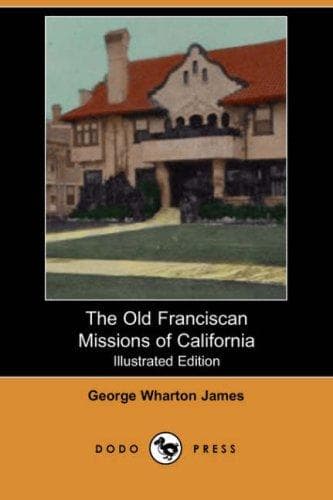
The Old Franciscan Missions Of CaliforniaJames, George Wharton
Religion
The Old Franciscan Missions Of California
James, George Wharton
Franciscans -- California; Spanish mission buildings -- California
This inn is an honest and just tribute to the influence of the Old
Mission Fathers of California, as necessary to a complete understanding
of the far-reaching power of their work as is _El Camino Real_, the
Mission Play, or the Mission Style of architecture. After listening to
lectures on the work of the Franciscan padres and visiting the Missions
themselves, its owners, Mr. and Mrs. Frank Miller, humanely interested
in the welfare of the Mission Indians, collectors of the handicrafts of
these artistic aborigines, and students of what history tells us of
them, began, some twenty-five years ago, to realize that in the Mission
idea was an ideal for a modern hotel. Slowly the suggestion grew, and as
they discussed it with those whose knowledge enabled them to appreciate
it, the clearer was it formulated, until some ten or a dozen years ago
time seemed ripe for its realization. Arthur B. Benton, one of the
leading architects of Southern California, formulated plans, and the
hotel was erected. Its architecture conforms remarkably to that of the
Missions. On Seventh Street are the arched corridors of San Fernando,
San Juan Capistrano, San Miguel and San Antonio de Padua; inside is an
extensive patio and the automobiles stop close to the Campanile
reproducing the curved pediments of San Gabriel. On the Sixth Street
side is the _fachada_ of Santa Barbara Mission, and over the corner of
Sixth and Orange Streets is the imposing dome of San Carlos Borromeo in
the Carmelo Valley, flanked by buttresses of solid concrete, copies of
those of San Gabriel.
The walls throughout are massive and unbroken by any other lines than
those of doors, windows and eaves, and the roofs are covered with red
tiles. In the Bell Tower a fine chime of bells is placed the playing of
which at noon and sunset recalls the matins and vespers of the
Mission days.
Within the building, the old Mission atmosphere is wonderfully
preserved. In the Cloister Music Room the windows are of rare and
exquisite stained glass, showing St. Cecilia, the seats are cathedral
stalls of carved oak; the rafters are replicas of the wooden beams of
San Miguel, and the balcony is copied from the chancel rail of the same
Mission. Mission sconces, candelabra, paintings, banners, etc., add to
the effect, while the floor is made in squares of oak with mahogany
parquetry to remind the visitor of the square tile pavements found in
several of the old Missions.
Daily--three times--music is called forth from the cathedral organ and
harp, and one may hear music of every type, from the solemn, stately
harmonies of the German choral, the crashing thunders of Bach's fugues
and Passion music, to the light oratorios, and duets and solos of
Pergolesi.
Public-domain text, read in full here on John Shaqi.
Reviews
Reviews
No reviews yet
Be the first to share your thoughts on this work.
Elsewhere in the archive
Join the Discussion
Join the discussion
Sign in to leave a comment or review.
Sign InorCreate an account