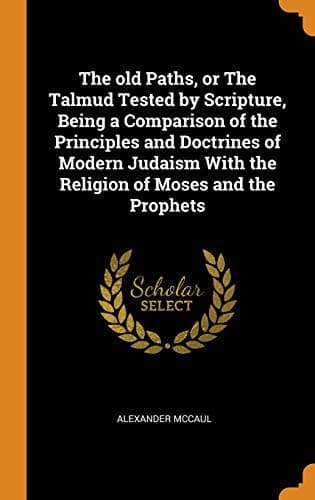
The old paths, or the Talmud tested by Scripture: Being a comparison of the principles and doctrines of modern Judaism with the religion of Moses and the prophetsMcCaul, Alexander
Religion
The old paths, or the Talmud tested by Scripture: Being a comparison of the principles and doctrines of modern Judaism with the religion of Moses and the prophets
McCaul, Alexander
Judaism -- Works to 1900
nation, and the power of the followers of Jesus of Nazareth protects you
from excommunication and corporal chastisement.
The cruelty and hardship of the imposition of a second holy day, with
such a punishment annexed appears not only from the circumstance of its
being altogether a human institution, but further, that the original
object of its institution has long since ceased. The Scribes appointed
the observance of two days at a time, when the feast-days were fixed by
the appearance of the moon, lest those at a distance from Jerusalem
should keep a wrong day, but now that they are fixed by calculation,
this is altogether unnecessary.
בזמן הזה שאין שם סנהדרים ובית דין של ארץ ישראל קובעין על חשבון זה היה מן
הדין שיהיו בכל המקומות עושין יום טוב אחד בלבד אפילו המקומות הרחוקות
שבחוץ לארץ כמו בני ארץ ישראל שהכל על חשבון אחד סומכין וקובעין אבל תקנת
חכמים הוא שיזהרו במנהג אבותיהם שבידם ׃
“In the present time, when there is no Sanhedrin, nor house of judgment
in the land of Israel, the feasts are fixed by calculation, and
therefore all places, even those that are remote from the land of
Israel, ought properly to observe only one day as a holy day, as well as
the inhabitants of that country, for all depend on and fix the feast by
one and the same calculation; but it is an ordinance of the wise men to
adhere diligently to the custom of their forefathers.” (Hilchoth Kiddush
Hachodesh, c. v. 5.) There is, therefore, no excuse for this burden
imposed upon the poor, and much less for the cruel punishments,
denounced against those who cease to observe what is confessedly an
useless custom. How different is the doctrine of Christianity with
respect to such days. No excommunication, no flogging, no imposing of
burdens upon the consciences of our brethren. The New Testament condemns
even all rash judgment in such matters. It says, “Who art thou, that
judgeth another man’s servant? To his own master he standeth or falleth.
Yea he shall be holden up, for God is able to make him stand. One man
esteemeth one day above another; another esteemeth every day alike. Let
every man be fully persuaded in his own mind. He that regardeth the day,
regardeth it to the Lord; and he that regardeth not the day, to the Lord
he doth not regard it. He that eateth, eateth to the Lord, for he giveth
God thanks; and he that eateth not, to the Lord he eateth not, and
giveth God thanks. For none of us liveth to himself, and no man dieth to
himself. For whether we live, we live onto the Lord, and whether we die,
we die unto the Lord; whether we live, therefore, or die, we are the
Lord’s.” (Rom. xiv. 2-8.) Here is the spirit of love and mercy, and
therefore the spirit of God. How is it, then, that Jesus and his
disciples were able to overcome the prejudices of their times, and to
stem the torrent of authority and learning, which was altogether in
favour of the opposite opinions? How is it, if they were impostors and
deceivers that they have left a tolerant and merciful system, whilst the
Public-domain text, read in full here on John Shaqi.
Reviews
Reviews
No reviews yet
Be the first to share your thoughts on this work.
Elsewhere in the archive
Join the Discussion
Join the discussion
Sign in to leave a comment or review.
Sign InorCreate an account