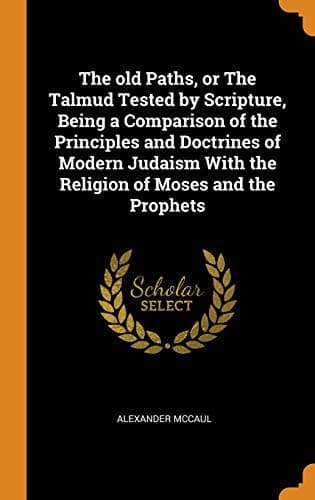
The old paths, or the Talmud tested by Scripture: Being a comparison of the principles and doctrines of modern Judaism with the religion of Moses and the prophetsMcCaul, Alexander
Religion
The old paths, or the Talmud tested by Scripture: Being a comparison of the principles and doctrines of modern Judaism with the religion of Moses and the prophets
McCaul, Alexander
Judaism -- Works to 1900
not thy friends, nor thy brethren, neither thy kinsmen nor thy rich
neighbours; lest they also bid thee again, and a recompense be made
thee. But when thou makest a feast, call the poor, the maimed, the lame,
the blind; and thou shalt be blessed; for they cannot recompense thee;
for thou shalt be recompensed at the resurrection of the just.” (Luke
xiv. 12-14). But excellent as this rabbinical commandment is in itself,
it loses considerably when interpreted according to the system. A person
acquainted only with the law of Moses, or the doctrine of Jesus of
Nazareth, would say, that one of the most lovely features in the command
is the universal love inculcated towards the stranger as well as the
Israelites. But an acquaintance with the oral law would compel him to
retract this commendation, for there universally the stranger is
interpreted to mean, “a proselyte to Judaism,” as for instance—
אהבת הגר שבא ונכנס תחת כנפי השכינה שתי מצוות עשה , אחת מפני שהוא בכלל
רעים , ואחת מפני שהוא גר והתורה אמרה ואהבתם את הגר ׃
“To love the stranger who comes, and is gathered under the wings of the
Shechinah, is to fulfil two affirmative precepts; one, because he is
included in the number of those considered ‘neighbours,’ and a second,
because the law says, ‘Ye shall love the stranger.’” (Hilchoth Deoth, c.
vi. 4.) Here, then, that comprehensive word “stranger” is narrowed down
to the signification “religious proselyte,” and abundance of similar
passages have already been given in Nos. 4 and 5. But even with this
great drawback we admit that there is much to be commended in the above
commandment. We are quite willing to recognize all the good which we
can, and therefore add another passage or two which deserve notice.
מדת החסידים אשר השם לנגדם תמיד ובכל דרכיהם ידעוהו בעת שמחתם אז יותר
ויותר מברכים ומשבחים להקב׳׳ה אשר שמחם . ויאמר האדם בלבו בעת שמחתו והנאתו
אם כך היא שמחת העולם הזה אשר הוא הבל כי יש אחרים תוגה וצער אם כן מה תהיה
שמחת העה׳׳ב התמידה שאין אחריה תוגה ׃
Public-domain text, read in full here on John Shaqi.
Reviews
Reviews
No reviews yet
Be the first to share your thoughts on this work.
Elsewhere in the archive
Join the Discussion
Join the discussion
Sign in to leave a comment or review.
Sign InorCreate an account