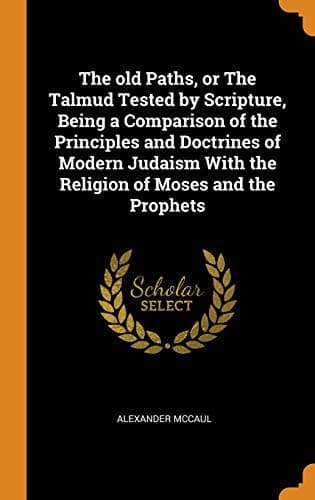
The old paths, or the Talmud tested by Scripture: Being a comparison of the principles and doctrines of modern Judaism with the religion of Moses and the prophetsMcCaul, Alexander
Religion
The old paths, or the Talmud tested by Scripture: Being a comparison of the principles and doctrines of modern Judaism with the religion of Moses and the prophets
McCaul, Alexander
Judaism -- Works to 1900
“He who can make the mixture, and does not, but chooses to depend on the
mixture made by the great men of the city, is called a sinner, and has
not fulfilled his duty.” (Arbah Turim, 527.) Here then his conscience is
burdened, but further, he may be exposed to considerable inconvenience,
to escape from which he is driven again to a prescribed exercise of
artifice and guile.
מי שלא הניח עירוב תבשילין ולא הניחו לו אחרים כשם שאסור לו לבשל ולאפות כך
קמחו ומאכלו אסור . ואסור לאחר שהניח לעצמו לבשל ולאפות לזה שלא הניח עד
שיקנה לו . שנמצא זה מבשל ואופה שלו שהרי קנהו ואם רצה יתן אחר כך לזה שלא
הניח במתנה ׃
“He that has not performed the ceremony of the mixture for himself, and
for whom others have not done it, as it is unlawful for him to boil or
to bake, so his flour and food are unlawful; and it is unlawful for
another, who has performed the ceremony for himself, to boil and bake
for such an one until he buy for himself. Then he may boil and bake of
his own, for he has bought it, and if he please may make a present of it
to the other.” Here of course the purchase is fictitious. In like manner
it is unlawful for him to light the Sabbath candle. This would be a
great misfortune, and a learned rabbi has accordingly found out a remedy
of the same kind.
כתב הר׳ מאיר מרוטנבורק שיכול לחפש בחדר שום חפץ בנר אפילו מבעוד יום
ולהניחנו דולק עד הלילה ׃
“Rabbi Meyer, of Rothenburg, has said in his writings, that a man may
seek for something in the room by the light of a candle, yea though it
be still day, and then leave it lighting until night.” (Arbah Turim,
527.) We ask the Jews seriously to consider this specimen of rabbinical
wisdom and conscientiousness. A man who has not performed the ceremony
of the mixture dare not do what God has allowed him to do, he dare not
light the candle for Sabbath, that is, if he does it honestly and
openly, he would, according to the oral law, commit a sin. But then he
may do this same thing by using guile and deceit, which God has
forbidden, and then according to these same teachers, the act is lawful.
He may light a candle under pretence of searching for something, even
though he has the daylight, and therefore evidently does not want it for
that purpose, and then he can leave it lighting. Thus the oral law
teaches that the neglect of a mere human invention is a greater sin than
guile and deceit. Is not this to strain at a gnat and to swallow a
camel? But some Rabbinist may say, if the oral law encourages guile and
deceit, why does it forbid the employment or guile in the preparation of
food for the Sabbath, as has been stated above? This is a curious point,
and deserves attention. The oral law says, if food be left after the
meals of the holy day, it is lawful to eat it on the Sabbath, provided
that no guile be used; but if guile be used, it is unlawful. Whereas, if
a man wilfully neglect the ceremony of the mixture, and cook
notwithstanding for the Sabbath he may lawfully eat what he has
prepared.
Public-domain text, read in full here on John Shaqi.
Reviews
Reviews
No reviews yet
Be the first to share your thoughts on this work.
Elsewhere in the archive
Join the Discussion
Join the discussion
Sign in to leave a comment or review.
Sign InorCreate an account