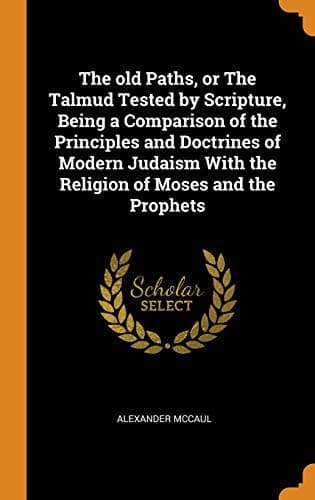
The old paths, or the Talmud tested by Scripture: Being a comparison of the principles and doctrines of modern Judaism with the religion of Moses and the prophetsMcCaul, Alexander
Religion
The old paths, or the Talmud tested by Scripture: Being a comparison of the principles and doctrines of modern Judaism with the religion of Moses and the prophets
McCaul, Alexander
Judaism -- Works to 1900
“And seek the peace of the city whither I have caused you to be carried
away captives, and pray unto the Lord for it: for in the peace thereof
shall ye have peace.” (Jerem. xxix. 7.) Now how does this command agree
with the above prayers? Suppose even that the rabbies were right, and
that Edom does mean Rome, how can the Jews there pray for its peace and
for its utter destruction at the same time? Those prayers are utterly
irreconcilable with this command of God, and therefore furnish another
proof of the error as well as the intolerance of the oral law. This was
the object which we had peculiarly in view. We do not wish to burden
every Israelite in London with this intolerance. Many are perhaps
ignorant that such prayers are offered in the synagogue—many overlook
them through inattention, and many others disapprove of them. But in
those who do know and disapprove, it is exceedingly inconsistent to join
in them, or to remain silent. The spirit of these prayers is thus
countenanced, and the intolerance handed down from generation to
generation. Children go to the synagogue, and hear these prayers
offered; they think as it is the language of prayer, of public prayer,
of the prayers of the people of Israel, it must be right. What other
conclusion can they form? Thus they imbibe the same spirit, and thus the
people of Israel are kept in bondage to the intolerance of by-gone
generations. But some will say, We acknowledge that these prayers are
contrary to the Bible. Remember, then, that in making this
acknowledgment, you admit the synagogue—yea, the whole nation of Jews,
has been in error for many centuries. And if the Jewish nation has been
universally mistaken upon so simple, yet essential, a point of religion
as true charity, it is highly probable that they are mistaken on other
points too, especially those that are more difficult and less obvious to
human reason. But above all, remember that whilst the whole system of
the oral law, in its precepts and prayers, has taught you to curse your
enemies, Jesus of Nazareth has taught us to bless. “Ye have heard that
it hath been said, Thou shalt love thy neighbour, and hate thine enemy:
but I say unto you, Love your enemies, bless them that curse you, do
good to them that hate you, and pray for them which despitefully use
you, and persecute you.” (Matt. v. 43, 44.) “Bless them which persecute
you: bless, and curse not.” (Rom. xii. 14.) But some Israelites may
still think that it is unfair to judge the oral law by this one service
to the Passover. Such an one we would remind of the blessing of the
Epicureans, as it is called, which he is bound to say—
בכל תפלה שבכל יום ׃
“in every prayer, every day.” (Hilchoth T’phillah, c. ii. 2.)
ולמלשינים אל תהי תקוה וכל עושי רשעה כרגע יאבדו והזדים מהרה יכרתו ומכניעם
במהרה בימינו . ברוך אתה ה׳ שובר אויבים ומכניע זדים ׃
Public-domain text, read in full here on John Shaqi.
Reviews
Reviews
No reviews yet
Be the first to share your thoughts on this work.
Elsewhere in the archive
Join the Discussion
Join the discussion
Sign in to leave a comment or review.
Sign InorCreate an account