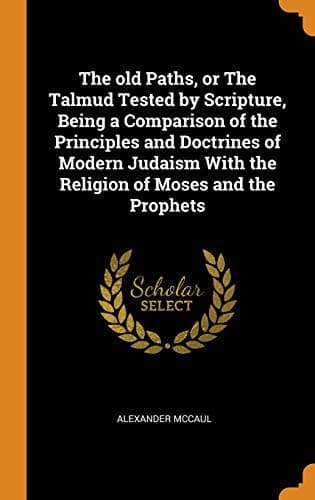
The old paths, or the Talmud tested by Scripture: Being a comparison of the principles and doctrines of modern Judaism with the religion of Moses and the prophetsMcCaul, Alexander
Religion
The old paths, or the Talmud tested by Scripture: Being a comparison of the principles and doctrines of modern Judaism with the religion of Moses and the prophets
McCaul, Alexander
Judaism -- Works to 1900
We have just considered the extraordinary command of the oral law, which
provides, that, if the reader in the synagogue should make a mistake in
reading the prayers, the congregation shall wait for him for an hour:
except the mistake occur in cursing the Epicureans, for then, “He is not
be waited for, but let another instantly rise up in his stead, for he
is, perhaps, infected with Epicureanism.” The special notice of this
case is as honourable to the Jews as it is condemnatory of the oral law.
It would appear from this that such mistakes had occurred. Readers in
the synagogues have sometimes stumbled and stammered when thy came to
this fearful malediction. And truly we are not surprised, if a man of
piety, acquainted with God’s Word, should be overwhelmed in publicly
cursing his fellow-men, and be unable to bring the words of imprecation
over his lips. The care which the Scribes took to legislate for such an
occurrence, implies an honourable testimony to the good feeling of the
nation, though it strongly marks their own intolerance, and forms a
striking contrast to the spirit inculcated in the teaching of Jesus of
Nazareth. When his disciples asked him to teach them to pray, he taught
them a short form; but short as it was, it contained the petition,
“Forgive us our trespasses, as we forgive them that trespass against
us,” and was followed by this admonition, “For if ye forgive men their
trespasses, your heavenly Father will also forgive you. But if ye
forgive not men their trespasses, neither will your Father forgive your
trespasses.” (Matt. vi. 14, 15.)
The intolerance which we have noticed, proves sufficiently that the
religious ideas of the oral law have not been drawn from Moses and the
prophets; and this will appear still further from the absurd legends
which are alluded to in the prayers of the synagogue, as if they were
acknowledged verities. In the Liturgy for the feast of Pentecost, which
is now approaching, we find more than one such allusion, to which we
would most earnestly call your attention. And first of all, those
prayers recognise the legend of Leviathan and Behemoth. In the morning
service for that day the Jews repeat the following words:—
מנת דילן דמלקדמין פרש בארמותא . טלולא דלויתן ותור טור רמותא , וחד בחד כי
סביך ועביד קרבותא . בקרנוהי מנגח בהמות ברברבותא . יקרטע נון לקבליה
בציצוי ובגבורתא . מקרב ליה בריה בחרביה ברברבותא . ארסטון לצדיקי יתקן
ושרותא , מסחרין עלי תכי דכדכוד וגומרתא , נגיין קמיהון אפרסמון נהרתא ,
ומתפנקין ורוי בכסי רויתא , חמר מרת דמבראשית נטיר ביה נעותא ׃
Public-domain text, read in full here on John Shaqi.
Reviews
Reviews
No reviews yet
Be the first to share your thoughts on this work.
Elsewhere in the archive
Join the Discussion
Join the discussion
Sign in to leave a comment or review.
Sign InorCreate an account