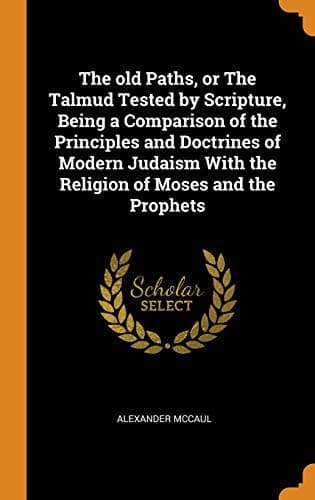
The old paths, or the Talmud tested by Scripture: Being a comparison of the principles and doctrines of modern Judaism with the religion of Moses and the prophetsMcCaul, Alexander
Religion
The old paths, or the Talmud tested by Scripture: Being a comparison of the principles and doctrines of modern Judaism with the religion of Moses and the prophets
McCaul, Alexander
Judaism -- Works to 1900
is all the pure invention of the rabbles, and we ask the Jews whether
such legends form fit subjects for the prayers or praises of the
synagogue, or whether they can be acceptable in the eyes of the God of
Israel? We do not mean to conceal the fact, that Christian prayer-books
may be found with legends as fabulous, and as foolish. But they are the
prayer-books of former generations, or of those who still adhere to
traditions of men. With them we have nothing to do. Three hundred years
have now elapsed since our forefathers cleared out all such follies. But
the Jewish prayer-books still remain unchanged, and unless the Jews make
some vigorous effort, the legend of Leviathan and Behemoth will be read
with all solemnity in the synagogues of England at the coming Feast of
Pentecost. It is grievous to think that that nation which once held up
the torch of Divine truth to enlighten the world, should still abide in
the darkness and superstitions of the Talmud. And yet this is, beyond
all doubt, the condition of Israel, so long as the Divine authority of
the Talmud is recognised in their public prayers. Individuals may say,
that they do not believe in its follies, nor cherish its intolerance,
but this cannot be said of the majority. The synagogue, in its public
worship, still pronounces the maledictions, and recites the legends of
the oral law, and thus declares, in the most solemn manner that can be
devised, that the religion of the Talmud is the religion of the
congregation. A mere confession of faith is nothing to such a
declaration as this. A man may trifle with his fellow-men, but
sentiments addressed to God in prayer or praise must justly be
considered as the language of the heart.
Public-domain text, read in full here on John Shaqi.
Reviews
Reviews
No reviews yet
Be the first to share your thoughts on this work.
Elsewhere in the archive
Join the Discussion
Join the discussion
Sign in to leave a comment or review.
Sign InorCreate an account