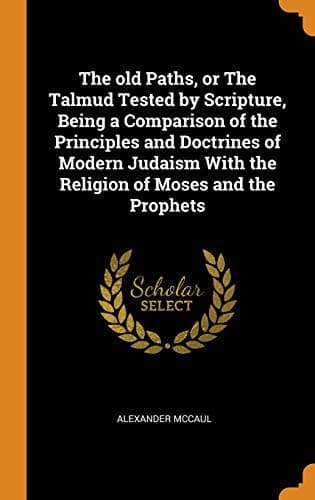
The old paths, or the Talmud tested by Scripture: Being a comparison of the principles and doctrines of modern Judaism with the religion of Moses and the prophetsMcCaul, Alexander
Religion
The old paths, or the Talmud tested by Scripture: Being a comparison of the principles and doctrines of modern Judaism with the religion of Moses and the prophets
McCaul, Alexander
Judaism -- Works to 1900
“R. Levi bar Chama says, R. Simon ben Lakish says, what is that that is
written ‘I will give thee tables of stone, and the law and the
commandment which I have written to teach them?’ ‘_The tables_’ are the
ten commandments. ‘_The law_’ is the written law. ‘The commandment’ is
the Mishna. ‘Which I have written’ means the prophets and sacred
writings. ‘To teach them’ means the Gemara. It teaches us that they were
all given to Moses from Sinai.” (Berachoth, fol. 5, col. 1.) Can any man
of common understanding receive this interpretation, which throws all
grammar and context to the winds, and gravely asserts that not only the
law and its explanation, but the prophets and the whole Talmud, were
given to Moses at Sinai? Will he give up his own reason and the word of
the living God to the authority of R. Simon ben Lakish? There cannot
possibly be any argument which would prove the falsehood of the
narrative concerning the oral law so completely as this interpretation,
which is regarded as one of its main foundations. The words of Moses
which are here perverted plainly speak of that which God had written. “I
will give thee tables of stone, and the law and the commandment which I
have written to teach them.” Did God write the oral law, and give it to
Moses? What became of it then? If it was written, how did it become
oral? These words “Which I have written,” have sadly puzzled the
rabbinical commentators, who know not how to reconcile the plain and
obvious sense of the words, with that interpretation which had been
already put upon them in the Talmud. Rashi seemed to think that the
difficulty might be got over by saying—
כל שש מאות ושלש עשרה מצוות בכלל עשרת הדברית הן ׃
“All the six hundred and thirteen commandments are comprehended in the
ten commandments.” (Com. in Exod. xxiv. 12.) But this, though true in
one sense, will not obviate the difficulty. God promises to give Moses
the law and the commandment which he had written. If the oral law had
not been written, it was not included. Saadiah Gaon, as quoted by Aben
Ezra, proposes another solution:—
אמר הגאון כי אשר כתבתי דבוק עם לוחות האבן לא עם התורה והמצוה כי השם לא
כתב רק עשרה הדברים ׃
“The Gaon says that the words, ‘_Which I have written_,’ are to be
connected with ‘_The tables of stone_,’ and not with ‘_The law and the
commandment_,’ for God wrote only the ten words.” But unfortunately
Moses has so connected them, and we have no warrant for reversing his
order. Aben Ezra himself, after giving the Talmudic exposition, gives it
as his own opinion, that these words refer to the ten commandments. He
says—
ולפי דעתי כי התורה הדבור הראשון והחמישי והמצוה השמונה הדברים ׃
Public-domain text, read in full here on John Shaqi.
Reviews
Reviews
No reviews yet
Be the first to share your thoughts on this work.
Elsewhere in the archive
Join the Discussion
Join the discussion
Sign in to leave a comment or review.
Sign InorCreate an account