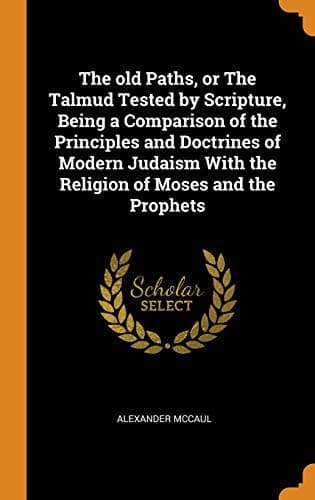
The old paths, or the Talmud tested by Scripture: Being a comparison of the principles and doctrines of modern Judaism with the religion of Moses and the prophetsMcCaul, Alexander
Religion
The old paths, or the Talmud tested by Scripture: Being a comparison of the principles and doctrines of modern Judaism with the religion of Moses and the prophets
McCaul, Alexander
Judaism -- Works to 1900
The Talmudists were satisfied, and their
wrath changed into profound admiration for his piety. These cases
exemplify the practical working of the rabbinic system. It burdens the
consciences of the sincere, and makes the unscrupulous hypocrites. It
may be replied that such things could not happen in England, and that
here the Jews are too enlightened to observe such distinctions. But
every one who makes this reply condemns modern Judaism as a religion
unfit for the observation of the enlightened, and if he be a
conscientious man, should protest against doctrines which he believes to
be false, and laws which he abhors as cruel. These Sabbatic laws are a
part, an essential part, of modern Judaism. There is not any part of the
oral law upon which Talmudists lay more stress. The man, therefore, who
does not observe them has changed his religion. He has got a new faith,
as really, as if he had been baptized and professed Christianity. Every
Israelite who carries a pocket-handkerchief in his pocket through the
streets of London on the Sabbath-day, has apostatized from that Jewish
religion, which has been professed for near two thousand years, and
practically declares that the religion of the synagogue is false. How
then can he, without hypocrisy, profess to believe in the religion of
the Jews? or how can he, as an honest man, uphold a system which he
regards as false, and which would have him executed as a criminal if it
had the power? If such persons, who live in the habitual transgression
of all the Sabbatic laws, have any regard for truth and for Divine
revelation, they should openly declare their sentiments, announce to the
world that they have forsaken the religion of their fathers, and assert
that religion which they regard as true. The blindest and most bigoted
Talmudist is a far more respectable man, and more acceptable in the
sight of God, than he who pretends to profess a religion in which he
does not believe, and whose precepts he regards as fanatical and
superstitious.
But to return. From the above laws it appears that it is a sin to carry
anything in a public jurisdiction a distance of more than four ells. But
suppose, then, that there was something which the Talmudists might find
it convenient or desirable to move to a greater distance, is there no
provision to effect its conveyance? Yes. These scrupulous persons, who
would stone a man to death for carrying anything five ells, have an
expedient for conveying it a hundred miles if necessary:—
לגיכך מותר לאדם לעקור החפץ מרשות הרבים ולתנו לחברו שאצלו בתוך ד׳ אמותיו
וחברו לחברו שאצלו אפילו ק׳ מילין אע׳׳פ שהחפץ הולך כמה מילין ברשות הרבים
שכל אחד לא יטלטלנו אלא בתוך ד׳ אמותיו ׃
Public-domain text, read in full here on John Shaqi.
Reviews
Reviews
No reviews yet
Be the first to share your thoughts on this work.
Elsewhere in the archive
Join the Discussion
Join the discussion
Sign in to leave a comment or review.
Sign InorCreate an account