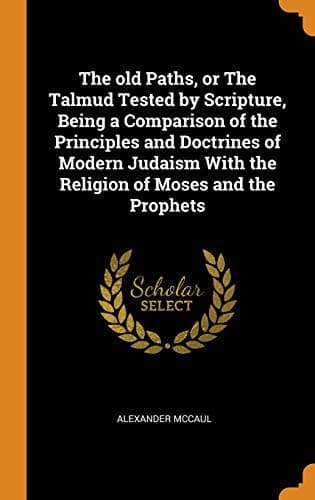
The old paths, or the Talmud tested by Scripture: Being a comparison of the principles and doctrines of modern Judaism with the religion of Moses and the prophetsMcCaul, Alexander
Religion
The old paths, or the Talmud tested by Scripture: Being a comparison of the principles and doctrines of modern Judaism with the religion of Moses and the prophets
McCaul, Alexander
Judaism -- Works to 1900
earned relaxation on which even the poor and the unlearned may lay aside
their worldly cares and occupations, and meditate upon the love and will
of God, and that eternity to which he is hastening. In the laws, then,
respecting the observance of this day, we might naturally expect the
spirit of devotion to be manifested; but in the oral law we look in vain
for anything of the kind. Its directions about the Sabbath are one
continued dry detail of external observances, which to a conscientious
man acquainted with them, must constitute a load upon his conscience,
sufficient to make the Sabbath the most unhappy day of all the seven.
But as to the poor and labouring classes, who have no time for study, it
is impossible that they should know, and much more that they should
keep, all that is necessary for the right observation of the rabbinic
Sabbath. If, therefore, the oral law were true, the poor must lose a
large portion of the blessings, and even be in danger of perdition. Nay,
if it be true, then we must believe that God has given a religion
impossible to be observed by the poor, and offering great advantages to
the rich and learned, that is that He is a respecter of persons, though
Moses and the prophets teach the contrary. But we would ask our readers,
what use is it to them to profess a religion of which they can never
attain a competent knowledge? We venture to affirm that the majority of
Israelites do not know enough of the oral law to help them to keep the
Sabbath, much less to observe the six hundred and thirteen commandments;
can it be said, then, that they possess a religion with which they are
not even acquainted? If the knowledge and practice of the oral law be
necessary to constitute a true Jew, ninety-nine out of every hundred
must give up their claims to the Jewish name. But then what is to become
of the Jewesses, who are not even obligated to learn? Every rabbi will
be willing to confess that the women at least are ignorant of the oral
law. Can they then have a portion in the world to come? If the knowledge
and practice of the oral law be necessary to salvation, they cannot. But
if they can be saved without it, then it follows that God has given a
law, the knowledge of which is not necessary to salvation. Let every Jew
ask himself this question, Am I acquainted with all the precepts of the
oral law? If not, can I be saved without this knowledge? If I cannot,
then the Jewish religion is one which makes it impossible for the poor
to be saved. If I can, then the Jewish religion is of no real use, for I
can be saved even without knowing it. Such a religion cannot be from
God. His religion is necessary to be known by every man, woman, and
child in the world, and the knowledge of it is just as easy to be
acquired by the poor and unlearned as by the rich and studious. Let then
the poor and the unlearned consider the folly of professing a religion,
with which they can never hope to become acquainted, and let them return
Public-domain text, read in full here on John Shaqi.
Reviews
Reviews
No reviews yet
Be the first to share your thoughts on this work.
Elsewhere in the archive
Join the Discussion
Join the discussion
Sign in to leave a comment or review.
Sign InorCreate an account