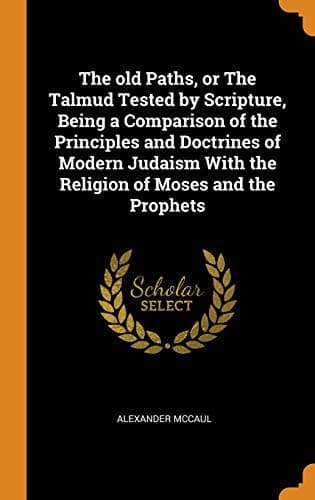
The old paths, or the Talmud tested by Scripture: Being a comparison of the principles and doctrines of modern Judaism with the religion of Moses and the prophetsMcCaul, Alexander
Religion
The old paths, or the Talmud tested by Scripture: Being a comparison of the principles and doctrines of modern Judaism with the religion of Moses and the prophets
McCaul, Alexander
Judaism -- Works to 1900
“And in like manner the wise man himself may, on account of his honour,
excommunicate an unlearned man who has treated him with contumely, and
there is no need of witnesses nor admonition. And the excommunicate
person is not to be absolved until he appease the wise man. But if the
wise man die, three persons come and absolve him. If, however, the wise
man wish to pardon, and not excommunicate him, the power is in his own
hand.” (Hilchoth Talmud Torah, c. vi. 12.) From this law we see that the
restoration of rabbinic power would be the most oppressive system of
government ever devised. Every learned man would be a petty tyrant,
constituting both judge and jury in his own person, and able, at his own
caprice, to inflict a severe punishment. The most absolute aristocracy
of the feudal times never dared to assume or exercise a power so
monstrous and so oppressive. No priesthood, even in the darkest times,
ever claimed such personal authority as is here given to every
individual rabbi. It is true that he may, if he please, forgive the
unfortunate offender, but it is much to be feared that such absolute
power would in most cases be too strong a temptation to the frail sons
of men. And at all events the principle is utterly inconsistent with
wise legislation, and most dangerous to the liberty of the poor and
unlearned; for the reader will observe that it is only an unlearned man,
an “am-haaretz,” who may be dealt with in this summary manner. And this
is another proof that the religion of the oral law is a religion devised
for the advantage of the rich and learned, but regardless of the
spiritual and temporal welfare of the lower classes. For the learned and
the great the law is very different:—
חכם זקן בחכמה וכן נשיא או אב ב׳׳ד שסרח אין מנדין אותו בפרהסיא לעקלם אלא
אם כן עשה כירבעם בן נבט וחביריו אבל כשחטא שאר חטאות מלקין אותו בצנעה
שנאמר וכשלת היום וכשל גם נביא עמך לילה אע׳׳פ שכשל כסהו בלילה , ואומרים
לו הכבד ושב בביתך וכן כל ת׳׳ח שנתחייב נידוי אסור לב׳׳ד לקפוץ ולנדותו
במהרה ׃
Public-domain text, read in full here on John Shaqi.
Reviews
Reviews
No reviews yet
Be the first to share your thoughts on this work.
Elsewhere in the archive
Join the Discussion
Join the discussion
Sign in to leave a comment or review.
Sign InorCreate an account