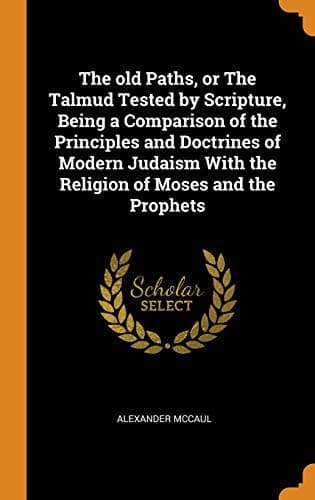
The old paths, or the Talmud tested by Scripture: Being a comparison of the principles and doctrines of modern Judaism with the religion of Moses and the prophetsMcCaul, Alexander
Religion
The old paths, or the Talmud tested by Scripture: Being a comparison of the principles and doctrines of modern Judaism with the religion of Moses and the prophets
McCaul, Alexander
Judaism -- Works to 1900
“_Therefore shalt thou stumble in the day._” This refers to Israel, and
means on account of thy deeds thou shalt stumble and fall. _This day_;
that is, in this time; thy fall shall soon come. And so we read, “Then
my anger shall be kindled against them in that day.” (Deut. xxxi. 17.)
And again, “In that day there shall be a root of Jesse,” (Isaiah xi.
10,) where day means time and period. _And the prophet also shall fall
with thee in the night_, that is, the false prophet who deceiveth thee
shall stumble with thee, as men stumble in the night in darkness; and so
the Targum of Jonathan has it. (Kimchi, Comment. in Hos. iv. 2.) Kimchi
and Jonathan, then, both testify that the oral law gives a false
interpretation of this verse. This is in itself rather awkward for a law
that professes to have been given by God, but still more so when it is
made the basis of most unjust and partial legislation, to save the
learned from the punishment which an unlearned man would have in similar
circumstances to suffer. No one can deny that the learned and unlearned
are here placed on very unequal terms. If an unlearned man provoke a
rabbi, he may be excommunicated by that individual without either judge
or jury, or even the form of a trial. But if a learned man makes himself
liable to the same punishment, even a court of justice has not the power
to pronounce the sentence. Who can doubt that the rabbies made these
laws for their own convenience? Can any one believe that God has given
this law, which makes the learned a privileged class of persons, who,
though guilty of the same offence as the working classes, is to be
spared, whilst they are to be punished? God is no respecter of persons,
and therefore no such law can be from him.
The extreme injustice of this mode of legislation will appear still more
from considering the nature of the punishment:—
מהו המנהג שינהג המנודה בעצמו ושנוהגין עמו , מנודה אסור לספר ולכבס כאבל
כל ימי נידויו , ואין מזמנין עליו , ולא כוללין אותו בעשרה לכל דבר שצריך
עשרה , ולא יושבין עמו בארבע אמות , אבל שונה הוא לאחרים ושונין לו , ונשכר
ושוכר , ואם מת בנדויו בית דין שולחין ומניחין אבן על ארונו , כלומר שחן
רוגמין אותו , לפי שהוא מובדל מן הציבור ואין צריך לומר שאין מספידין אותו
ואין מלוין את מטתו ... מי שישב בנידויו שלשים יום ולא בקש להתירו מנדין
אותו שנייה ישב שלשים יום אחרים ולא בקש להתירו מחרימין אותו ׃
Public-domain text, read in full here on John Shaqi.
Reviews
Reviews
No reviews yet
Be the first to share your thoughts on this work.
Elsewhere in the archive
Join the Discussion
Join the discussion
Sign in to leave a comment or review.
Sign InorCreate an account