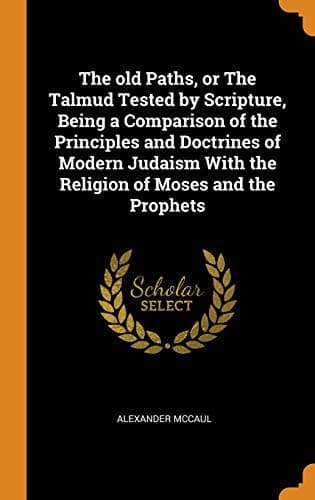
The old paths, or the Talmud tested by Scripture: Being a comparison of the principles and doctrines of modern Judaism with the religion of Moses and the prophetsMcCaul, Alexander
Religion
The old paths, or the Talmud tested by Scripture: Being a comparison of the principles and doctrines of modern Judaism with the religion of Moses and the prophets
McCaul, Alexander
Judaism -- Works to 1900
“Thousands and ten thousands of congregations, which have persecuted us
and are vanished, were not able to justify themselves in purity. Lo! the
heavens are not pure in his sight, and all the heavenly angels are as
beaten flax: how then can he that is filthy and abominable be pure? He
gathereth riches by deceit; and working in secret, he says in his heart,
Who can bear witness against me before him? Even the beams, rafters,
planks, and stones of his house. O Thou who art too pure of sight to
view evil, sink our sins in the deepest recesses, and work the good sign
for us.” (Prayers for the New Year, p. 149.) Here is an express
acknowledgment that the congregations of old could not justify
themselves by merit, an assertion in the words of the Psalm, that all
men are filthy and abominable, and a prayer, not for payment of deserts,
but for forgiveness of sins. If this prayer contain the sentiments of
truth, and be offered in sincerity, then Israel has no merits, and the
doctrine, that any man is justified by the superabundance of his merits,
is a mere fiction. The man who will venture to offer this prayer, and
yet hope to be saved by his good deeds, is a hypocrite, or is not right
in his mind. Here again, then, the oral law is inconsistent with itself:
for here it places the hope of salvation not in merit, but in the free
and undeserved mercy of God. It is the duty of every Israelite,
therefore, to ascertain which of the two ways is in accordance with the
declaration of Moses and the prophets. It is impossible that they should
both be true. The fact appears to be, that the authors of the oral law,
like all other men, loved the honour and glory of personal
righteousness, and hoped that all those deeds, and fasts, and
almsgiving, which were so lovely in their own eyes, and gained them so
much credit amongst men, would also be duly acknowledged at the bar of
God’s judgment. At the same time their conscience was continually
awakened and terrified by the plain declarations of the Word of God, and
therefore, to quiet their conscience, they were driven even against
their wills to acknowledge their guilt, and to seek for a quietus. This
they partly found in the hope of free mercy, but partly in inventions of
their own. They placed no small dependence upon fasting and almsgiving,
but their troubled conscience was not satisfied with these, and they
have therefore fled for refuge to observances the most trivial, and
hopes the most childish. By blowing the horn the whole month of Elul,
they hope to deceive Satan, so that he may not know which is the first
day of the new year, and may not be able to accuse them:—
לכן התקינו חז׳׳ל שיהיו הוקעין בר׳׳ח אלול בכל שנה ושנה וכל החודש כדי
להזהיר את ישראל שיעשו תשובה שנאמר אם יתקע בשופר וגו׳ וכדי לערבב השטן ׃
Public-domain text, read in full here on John Shaqi.
Reviews
Reviews
No reviews yet
Be the first to share your thoughts on this work.
Elsewhere in the archive
Join the Discussion
Join the discussion
Sign in to leave a comment or review.
Sign InorCreate an account