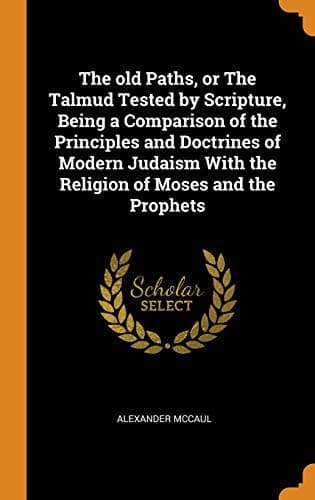
The old paths, or the Talmud tested by Scripture: Being a comparison of the principles and doctrines of modern Judaism with the religion of Moses and the prophetsMcCaul, Alexander
Religion
The old paths, or the Talmud tested by Scripture: Being a comparison of the principles and doctrines of modern Judaism with the religion of Moses and the prophets
McCaul, Alexander
Judaism -- Works to 1900
“At this time, when there is no temple, and we have no altar, there is
no atonement but repentance. Repentance atones for all transgressions,
yea, though a man be wicked all his days, and repent at last, none of
his wickedness is mentioned to him, for it is said, ‘As for the
wickedness of the wicked, he shall not fall thereby, in the day that he
turneth from his wickedness.’ (Ezek. xxxiii. 12.) The Day of Atonement
itself also atones for them that repent, for it is said, ‘For on that
day he shall make an atonement for you.’ Lev. xvi. 30.” (Hilchoth
T’shuvah, c. i. 2.) This is the last refuge of Jewish hope, and we,
therefore, propose to consider, whether it is a refuge on which a
reasonable man may hazard his hope of salvation? No man of sense would
hazard his life or his property upon a statement, of which one part
contradicted the other; and such is the statement which we have just
read. It first tells us, that in this present time “There is no
atonement but repentance,” and that “Repentance atones for all
transgressions;” and yet, immediately after, it adds, that “The Day of
Atonement itself atones for them that repent.” Now the latter assertion
contradicts the former. If the Day of Atonement, as is here asserted, be
necessary to atone for the penitent, then it is not true, that
repentance atones for all sins. But if repentance atones for all sins,
then when a man repents, his sins are forgiven, and then the Day of
Atonement is not necessary. There is here, therefore, a palpable
contradiction, and it cannot be safe to trust to a hope at variance with
itself. But, secondly, as the two parts of which this statement is
composed, contradict each other, so each of them is contrary to the law
of Moses. The first of them is, that “Repentance atones for all
transgressions;” but if so, then the atonement prescribed by Moses is
useless, in fact, it is no atonement at all. Moses says, that the two
goats were appointed by God for the atonement, but here it is said, that
repentance is, in itself, sufficient. If this be true, if repentance can
now atone for sins, without any sacrifice, why did Moses appoint such an
useless, and even cruel rite, as the taking away the lives of poor
innocent animals? If repentance be sufficient now, it was sufficient
always, and then it follows, that God commanded what was useless. But if
the appointment, the slaying of one goat, and the sending the other,
laden with the sins of the people, into the wilderness, was necessary
formerly to procure forgiveness of sins, it must be equally necessary
now: unless the rabbies will take upon them to assert, that God is an
arbitrary and changeable master, who, to forgive sins, at one time,
requires what at another time he does not require. That the slaying of
one goat, and the sending away of the other was once absolutely
necessary, no man can deny. Moses prescribes it so plainly, that if
there be one thing more plain than another, it is this, that when the
Public-domain text, read in full here on John Shaqi.
Reviews
Reviews
No reviews yet
Be the first to share your thoughts on this work.
Elsewhere in the archive
Join the Discussion
Join the discussion
Sign in to leave a comment or review.
Sign InorCreate an account