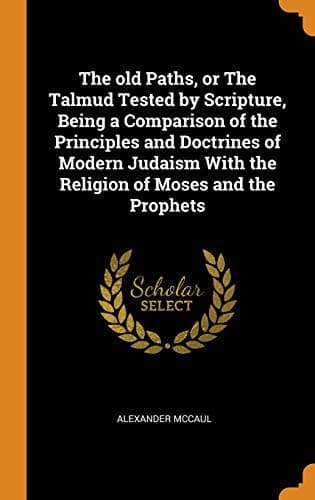
The old paths, or the Talmud tested by Scripture: Being a comparison of the principles and doctrines of modern Judaism with the religion of Moses and the prophetsMcCaul, Alexander
Religion
The old paths, or the Talmud tested by Scripture: Being a comparison of the principles and doctrines of modern Judaism with the religion of Moses and the prophets
McCaul, Alexander
Judaism -- Works to 1900
“But if the time of my visitation to death be near, O let my death be an
expiation for all my sins, iniquities, and transgressions, wherein I
have sinned, offended, and transgressed against thee, from the day of my
existence.” These two doctrines are plainly contrary the one to the
other. If death be an atonement for all sins, then, when it is once
suffered, all these sins are forgiven, and there is no need of further
punishment in hell for twelve months. But if this further punishment be
inflicted, then the death of the individual is not an atonement for his
sins. The Jew may choose which of these hopes he pleases; but whichever
he may assert to be true, the other is necessarily false; and if one be
false, then the oral law teaches falsehood, and cannot be depended upon
with respect to the other. There is, then, in these two statements, a
glaring inconsistency, which makes them both suspicious in themselves:
and the Word of God is as opposed to this last statement, as to the
former. The Bible represents death as a consequence and punishment of
Adam’s sin, not as an atonement: and hence it is that infants die, who
have never committed actual sin, and do not need an atonement on that
account. Death is, therefore, a punishment, and that which is a
punishment can never be an atonement. The dying Jew, then, if he be a
reasonable man, has no hope that can yield him peace and consolation in
that solemn hour. He prays that his death may atone for his sins, and
yet believes the very contrary—that he is going down to the place of the
damned, and that his son will have to undertake the work of his
redemption. How any thoughtful man, especially how any Israelite who has
read the Law and the Prophets, can be content with such a religion, we
cannot comprehend. The very essence of religion, the very consideration
that gives it any value, is the comfort which it affords to the
departing sinner. If it cannot soothe, support, and comfort him in the
hour of death, it is not worth the having. The Christian faith is very
different, and, in our opinion, far more in accordance with the Old
Testament. We believe, in the first place, that there is a full and
perfect pardon for all sins by the atonement of the Messiah, so that the
sinner who dies in repentance and faith, is delivered from all
punishment and other consequences of sin, and enters at once into the
abodes of the blessed, there to await the morning of the resurrection.
The Old Testament promised that Messiah should bear our sins. The New
Testament tells us that He has borne them, and that therefore we can
“now be justified from all things from which we could not be justified
by the law of Moses.” (Acts xiii. 38, 39.) It tells us that “God made
Him to be sin for us, who knew no sin; that we might be made the
righteousness of God in him” (2 Cor. v. 21); and “that if any man sin,
we have an advocate with the Father, Jesus, the Messiah, the Righteous;
Public-domain text, read in full here on John Shaqi.
Reviews
Reviews
No reviews yet
Be the first to share your thoughts on this work.
Elsewhere in the archive
Join the Discussion
Join the discussion
Sign in to leave a comment or review.
Sign InorCreate an account