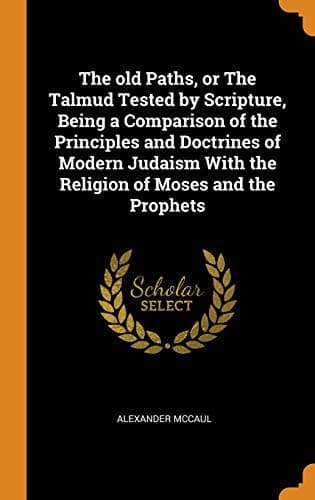
The old paths, or the Talmud tested by Scripture: Being a comparison of the principles and doctrines of modern Judaism with the religion of Moses and the prophetsMcCaul, Alexander
Religion
The old paths, or the Talmud tested by Scripture: Being a comparison of the principles and doctrines of modern Judaism with the religion of Moses and the prophets
McCaul, Alexander
Judaism -- Works to 1900
“These are the impediments in human beings. The film that is outside the
eye. The incrustation outside a wound. Dry blood that is on a wound. The
plaster that is on it. Filth upon the flesh. The impurity or dirt under
the nails. Dirt upon the body, mud, potter’s clay, &c.” (Ibid., c. ii.
1.) Every one of these can give rise to endless questions in casuistry,
which are evidently beyond the powers of the unlearned, and must draw
him, if he be a conscientious man, to the Rabbi to solicit his advice.
Thus, one of the very first commandments with which the Jew begins the
day, requires for its accurate fulfilment a degree of knowledge which is
far beyond the attainment of the multitude. This one commandment
involves scores of others. Nay, we doubt not that an accurate Talmudist
might make 613 constitutions out of this one alone; and we appeal to the
conscience of the great majority of Jews in London to decide whether
they possess the knowledge here required, and consequently whether it is
possible for them to keep this one commandment. If they transgress any
one of these Rabbinic distinctions, their hands are not washed, and
consequently they are unfit for prayer. But this is not a command for
the morning only. It must be repeated through the day.
כל האוכל הפת שמברכין עליו המוציא צריך נטילת ידים תחלה וסוף , ואף על פי
שהוא פת חולין ואף על פי שאין ידיו מלוכלכות ואינו יודע להן טומאה לא יאכל
עד שיטול שתי ידיו , וכן כל דבר שטיבולו במשקה צריך נטילת ידים תחלה ׃
“Every one who eats that sort of bread, for which the benediction is,
‘Blessed art thou, O Lord our God, King of the universe! who bringeth
forth bread from the earth,’[16] is bound to wash his hands at the
beginning and end. And although the bread be common, and although his
hands have not been defiled, and he is not aware of any uncleanness upon
them, he is not to eat until he wash both his hands. And thus, also,
with regard to anything that is dipped in fluid, the washing of hands is
necessary at the beginning.” (Hilchoth Berachoth, vi. 1.) Here, again,
it is necessary to know the different sorts of bread, and the compounds
that may be made with the different sorts of flour, and the various
forms of benediction, and out of these again may arise as many doubts
and questions as out of the former, for the solution of which learning,
acuteness, and practice are required; and the want of these may lead to
transgression, and, according to the Rabbies, to most fatal
consequences. For instance, neglect of this command after the meal may
cause blindness.
כל פת שהמלח בו צריך נטילת ידים באחרונה שמא יש בו מלח סדומית או מלח שטבעו
כמלח סדומית ויעביר ידיו על עיניו ויסמא . מפני זה חייבין ליטול ידים בסיף
כל סעודה מפני המלח . ונמחנה פטורִם מנטילה ידים בתחלה . מפני שהם טרודים
במלחמה וחייבין באחרונה מפני הסכנה ׃
Public-domain text, read in full here on John Shaqi.
Reviews
Reviews
No reviews yet
Be the first to share your thoughts on this work.
Elsewhere in the archive
Join the Discussion
Join the discussion
Sign in to leave a comment or review.
Sign InorCreate an account