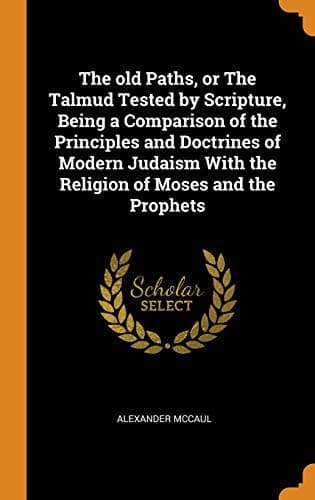
The old paths, or the Talmud tested by Scripture: Being a comparison of the principles and doctrines of modern Judaism with the religion of Moses and the prophetsMcCaul, Alexander
Religion
The old paths, or the Talmud tested by Scripture: Being a comparison of the principles and doctrines of modern Judaism with the religion of Moses and the prophets
McCaul, Alexander
Judaism -- Works to 1900
“A question proposed to Rashi—Suppose that an Israelite and a Gentile
had an oven in partnership, shall he say to the Gentile, Take thou the
profit during the Passover, and I will take afterwards? He replied, Let
him make a bargain before the Passover, and take the price of that
week.” (Ibid.) A man of common sense will see that here, as in the other
cases, the Jew does really receive the profit from leaven in existence
during the Passover, and that whether he receive the money or the profit
before or afterwards, there is no real difference in the circumstances
of the transaction; one principle pervades all these decisions, and that
is, evasion of what is considered a Divine command. The man who gives
away the leaven with the full intention of resuming possession after the
Passover, and the man who sells only for the week, in full persuasion
that his right and interest remain, does in reality neither give nor
sell. There may be an outward appearance of the thing, but God does not
judge according to the appearance; he looks on the intention of the
heart. He is not satisfied with the form of giving or selling, but
looking at the inmost thoughts of the soul, He sees that the man does
not wish nor intend to do either one or the other, and marks him as a
deliberate, and wilful transgressor. But we appeal to every
unsophisticated mind in Israel, would such a system of evasion be
considered as honourable, even according to the maxims of this world? Or
can that conduct, which men would call dishonourable, be considered as
an acceptable service before God? But, above all, can it be the law
given to Moses by the God of truth? This it is which gives this
discussion all its importance. If the Talmud and all its decisions were
retained merely as a curious remnant of antiquity, as the effusions of a
perverse ingenuity, or the waking dreams of scholastics, we might both
pass it by with a smile. But it is proposed as the law of God. It is the
religion of the great majority of the Jewish people, and no doubt at
this very time, many an Israelite in Poland and elsewhere, if not in
England, is preparing a mock sale, or drawing up a contract for the
imaginary disposal of the leaven in his possession, in obedience to the
above directions. They do it in simplicity, with a mistaken devotion.
They are misled; but does not a fearful load of responsibility rest upon
those Israelites who know better, and yet leave their brethren in this
grievous error, yea, and confirm them in it by joining in all the
ceremonies which that system prescribes? Because of this system, the
nation is still exiled from the land of Israel. Because of this system,
the anger of the Lord is not turned away, but His arm is stretched out
still. If then you love your people—if you desire their national
exaltation, and their eternal welfare, lift up your voice and protest
against the oral law. Condemn the Scribes and Pharisees as the inventors
Public-domain text, read in full here on John Shaqi.
Reviews
Reviews
No reviews yet
Be the first to share your thoughts on this work.
Elsewhere in the archive
Join the Discussion
Join the discussion
Sign in to leave a comment or review.
Sign InorCreate an account