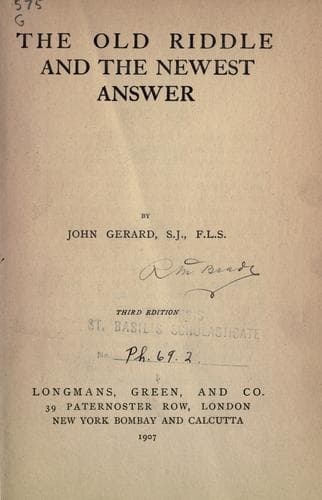
The result has been to make it evident that while modern discovery has
immensely multiplied and magnified the marvels which have to be
accounted for, it has disclosed nothing which can be supposed to account
for them in a manner to satisfy our reason. So far as the forces of
Nature are concerned, the mysteries that lie beyond are even darker than
they were. The origin and nature of matter and force, the source of
motion, of life, of sensation and consciousness, of rational
intelligence and language, of Free-will, of the reign of law and order
to which all Nature testifies,--all these are for Science utterly
unsolved problems, which, as some amongst her teachers tell us, must
remain for ever insoluble. Even less prospect, if possible, can there be
that any mechanical forces will ever account for perception of the
sublime and beautiful,--and above all--of the distinction between right
and wrong.
Here, then, Science stops,--confessing that she can be our guide no
farther, and lending no colour whatever to the unscientific pretensions
which are so noisily advanced by some persons in her name. Her domain
is the world of sense, and it is evident that nothing existing within
that realm can possibly furnish an explanation which will satisfy our
intellectual need for causality.
Are we therefore to say that we can know nothing concerning the First
Cause to which the phenomena of the Universe are due? Such is the
Agnostic's position. What we have no means of knowing, he says, we must
not pretend to know. It were irrational and dishonest to do so. When
Science fails us, the true wisdom is to profess ignorance,--thus only
can our position still be scientific.
But is such a principle itself scientific? Is it not a gratuitous and
monstrous assumption that we can know nothing but that of which our
senses directly tell us? That the Universe has a cause is no less
certain than that the Universe exists, for of that cause it is the
monument. And, as of the whole, so of every part or element which it
contains, it is absolutely certain that there must be a cause, and one
adequate to the production of what has actually been produced; for as
the proverb says, "Nothing is to be got out of a sack but what is in
it." From such conclusions there is no escape;--and since it is
impossible to find the cause required within the world of material
forces and sensible phenomena, it becomes no less obvious that it must
lie beyond, across the frontier which nothing material can pass.
* * * * *
Public-domain text, read in full here on John Shaqi.
Reviews
Reviews
No reviews yet
Be the first to share your thoughts on this work.
Elsewhere in the archive
Join the Discussion
Join the discussion
Sign in to leave a comment or review.
Sign InorCreate an account