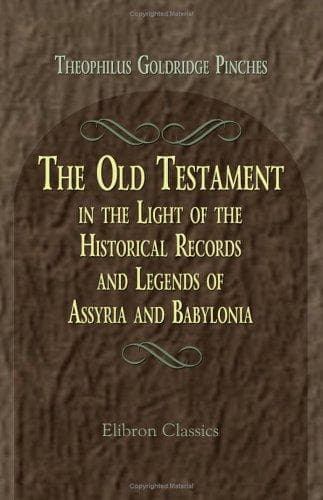
The Old Testament in the Light of the Historical Records and Legends of Assyria and BabyloniaPinches, Theophilus G. (Theophilus Goldridge)
Religion
The Old Testament in the Light of the Historical Records and Legends of Assyria and Babylonia
Pinches, Theophilus G. (Theophilus Goldridge)
Bible. Old Testament -- Criticism, interpretation, etc.
In the province of which Sippar was capital, however, the people were more
than usually religious, or else more records of their piety have come down
to us. Numerous persons, more especially women, are described as devotees,
or perhaps priestesses, of the Sun-god there, and sometimes similar
devotees of Merodach are mentioned. Though we have no certain information,
it is very probable that there were all over the country people dedicated
to the various deities, “the gods of the land,” for what was customary in
the district of Sippar (Sippar-Amnanu and Sippar-Ya’ruru) was in all
probability equally so in the other provinces of the empire. From the
earliest times the temples acquired and held large tracts of land, which
the priests let to various people, agriculturists and others, to
cultivate, a certain proportion of the produce being paid to them, added
to the revenues of the temples, and passed into the treasury of the god.
To this lucrative business of land-letting was added that of
money-lending, and interest in the weaving-industry of the place, both of
which increased enormously in later times. That the temples received from
time to time rich gifts from the king, goes without saying, for the
colophon-dates record many instances of this. Sumu-abu, for instance,
rebuilt or restored the temples of the Lady of Isin, and the temple Ê-maḫ
of Nannar (the Moon-god); Sumu-la-îla made a throne of gold and silver for
the great shrine of Merodach; Abil-Sin seems to have given a similar
object to the temple of the Sun at Babylon; Ḫammurabi restored or gave
thrones to the temples of Zer-panitum, Ištar of Babylon, Nannar (the
moon), and built a great shrine for Bel. Samsu-iluna, likewise, was not
negligent of the gods, for it is related of him that he dedicated a bright
shining mace (?) of gold and silver, the glory of the temple, to Merodach,
and made Ê-sagila (the great temple of Belus at Babylon) to shine like the
stars of heaven. It is needless to say, that the long lists of the pious
works of the rulers of Babylon would be much too long to enumerate here.
All this the kings did from motives of policy, to conciliate the priests,
and, through them, the people. Sometimes, though, they had need of the
priests, who were able to render them service, and then, naturally, they
bought their good-will cheerfully. The service which the priests rendered
in return was to pray to the gods for the king’s health and his success
against his enemies, or in any undertaking in which he might be engaged,
and to inquire of the gods for him whether he would be successful. Many,
too, were the ceremonies and festivals in which king, priests, and people
took part, and the king (who was himself a priest) and the priesthood
thrived exceedingly.
Public-domain text, read in full here on John Shaqi.
Reviews
Reviews
No reviews yet
Be the first to share your thoughts on this work.
Elsewhere in the archive
Join the Discussion
Join the discussion
Sign in to leave a comment or review.
Sign InorCreate an account