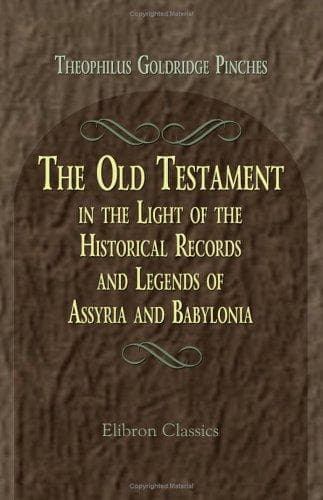
The Old Testament in the Light of the Historical Records and Legends of Assyria and BabyloniaPinches, Theophilus G. (Theophilus Goldridge)
Religion
The Old Testament in the Light of the Historical Records and Legends of Assyria and Babylonia
Pinches, Theophilus G. (Theophilus Goldridge)
Bible. Old Testament -- Criticism, interpretation, etc.
In all probability the Babylonians consisted of what may be called the
original Semites of that tract, with the Akkadians, also aboriginal, with
whom they lived and had already, at the time of the dynasty of Babylon,
mingled to such an extent that they must have become a homogeneous people,
notwithstanding the racial differences which were probably noticeable at
certain points—for example, a more strongly-marked Semitic type at Sippar
and in that neighbourhood, and a more strongly-marked Akkadian type in the
State to which Lagaš belonged. Other invasions, however, seem to have
taken place, the principal being that of the Amorites, to which allusion
has already been made—an invasion which the tablets of this period
indicate to have been sufficiently numerous, and which must have left its
mark on the population, to all appearance increasing the Semitic
preponderance, and emphasizing the type. The existence of an “Amorite
tract” in the district of Sippar, and the fact that Sin-idinnam,
Ḫammurabi’s general, is designated by the characters GAL-MAR-TU, in
Semitic Babylonian _Rab-Amurrî_, “chief of the Amorite(s),” are in
themselves sufficient testimony to this invasion. It is noteworthy, too,
that the dynasty to which Ḫammurabi belonged is apparently that described
by Berosus as “Arabic,” in which case we should have to recognize yet
another invasion of Semites; but there is just the probability, that
“Arabic” and “Amorite” were interchangeable terms, the Amorites being
regarded as a collection of wandering hordes of whom a portion entered the
country, and took possession of the government. In any case, they shared
the fate of all invaders of the kind referred to, for they were speedily
conquered by the superior civilization of the conquered, and became so
naturalized that notwithstanding their western names, they were called by
the Babylonians “the dynasty of Babylon.” This Amorite element was to all
appearance a sufficiently large one, as the more easily recognizable names
show. Thus we have _Amurrū-bani_, _Karasumia_, _Asalia_, _Kuyatum_,
_Bizizana_, _Izi-idrê_, _Sumu-raḳ_, _Betani_, _Sar-ili (Israel)_,
_Awel-Addî_ (“man of Hadad,” described an Amorite,) with many others,
though the different nationalities cannot always be distinguished, as many
Amorites bore Babylonian names, and _vice versâ_.
Naturally other nationalities than the Babylonians, Akkadians, Šumerians,
and Amorites were represented in the country—Elamites from the invasions
of earlier centuries, Kassites and Sutites who came, in all probability,
to trade, Qutites or Gutians brought into the country as slaves, or
possibly living there as freemen—all these and others helped to increase
the confusion of tongues which existed in the land from remote ages, and
reminded people of the legend of the Tower of Babel, when “the Lord did
there confound the language of all the earth.”(25)
Public-domain text, read in full here on John Shaqi.
Reviews
Reviews
No reviews yet
Be the first to share your thoughts on this work.
Elsewhere in the archive
Join the Discussion
Join the discussion
Sign in to leave a comment or review.
Sign InorCreate an account