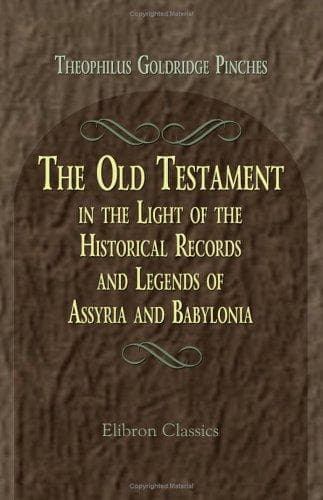
The Old Testament in the Light of the Historical Records and Legends of Assyria and BabyloniaPinches, Theophilus G. (Theophilus Goldridge)
Religion
The Old Testament in the Light of the Historical Records and Legends of Assyria and Babylonia
Pinches, Theophilus G. (Theophilus Goldridge)
Bible. Old Testament -- Criticism, interpretation, etc.
In whatever part of Babylonia, however, the patriarch may have sojourned,
of one thing there is no doubt, and that is, that if he dwelt there, the
life which he saw around him, and in which he must have taken part, was
that depicted by the tablets translated in the foregoing chapter. He saw
the idolatry of the people, and the ceremonies and infamies which
accompanied it; he saw the Babylonians as they were in his day, with all
their faults, and all their virtues—their industry, their love of trade,
their readiness to engage in litigation, and all the other interesting
characteristics which distinguished them. He must have been acquainted
with their legends of the Creation, the Flood, and all their gods and
heroes, and the poetry for which the Hebrew race has always been renowned
must have had its origin in the land of Nimrod, whence Abraham of old went
forth free, and his descendants, a millennium and a half later, returned
as captives.
How it came about (if it be really true) that Terah was an idolater,
whilst his son Abram was a monotheist, will probably never be known. It is
only reasonable to suppose, however, that among a people so intelligent as
the Babylonians, there were at least some who, thinking over the nature of
the world in which they lived and the destiny of mankind, saw that the
different gods whom the people worshipped could not all be governors of
the universe, but, if they existed at all, must be only manifestations of
the Deity who held the supreme power. Indeed, it was, to all appearance,
this doctrine which really prevailed, as is shown by the text translated
on p. 58. Whether taught generally to the learned class (the scribes) or
not, is not known, but it must have been very commonly known to those who
could read, otherwise it is hardly likely that such a tablet would have
been drawn up and written out again at a later date (the text we possess
being but a copy of a lost original). As the divinity with whom the others
are identified is Merodach, it is most likely that this special doctrine
of the unity of the Deity became general some time after the commencement
of the Dynasty of Babylon (that to which Ḫammurabi or Amraphel belonged),
when the city of Babylon became the capital of the country. Abram’s
monotheism would, therefore, naturally fit in with the new doctrine which
apparently became the general belief of the learned class at this
time.(36)
Public-domain text, read in full here on John Shaqi.
Reviews
Reviews
No reviews yet
Be the first to share your thoughts on this work.
Elsewhere in the archive
Join the Discussion
Join the discussion
Sign in to leave a comment or review.
Sign InorCreate an account