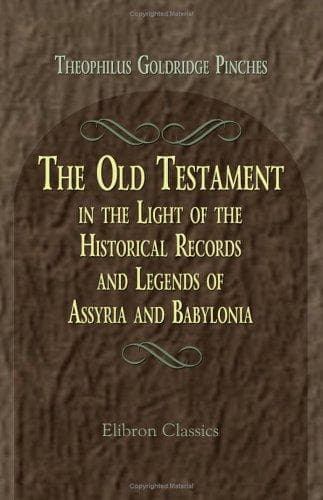
The Old Testament in the Light of the Historical Records and Legends of Assyria and BabyloniaPinches, Theophilus G. (Theophilus Goldridge)
Religion
The Old Testament in the Light of the Historical Records and Legends of Assyria and Babylonia
Pinches, Theophilus G. (Theophilus Goldridge)
Bible. Old Testament -- Criticism, interpretation, etc.
KUR MAR-TU šad A-mur-ri-e Mountain of Amoria
KI (the Amorite
land).
KUR TI-ID-NU-UM šad A-mur-ri-e Mountain of
KI Amoria.
KUR GIR-GIR šad A-mur-ri-e Mountain of
KI Amoria.
KUR SU-RU šad Su-bar-ti Mountain of
KI Subarti.
KUR NUM-MA šad Elamti Mountain of Elam.
KI
KUR Gu-ti-um šad Gu-ti-i Mountain of Gutû
KI or Gutium.
KURZAG Gu-ti-um šad pa-at Gu-ti-i Mountain of the
KI border of Gutium.
KUR ši-rum šad Si-ri-i [?] Mountain of Širû.
KI
KUR [GIŠ] ERI-NA šad E-ri-ni Mountain of Cedar.
KI
KUR MAR-ḪA-ŠI KI šad Pa-ra-ši-i Mountain of
Parašû.
KUR Šir-rum šad Bi-ta-lal Mountain of
KI Bitala. (Kaštala
is possible.)
KUR Ê-AN-NA šad Bi-ta-lal Mountain of
KI Bitala.
KUR ḪE-A-NA šad Ḫa-ni-e Mountain of Ḫanû.
KI
KUR Lu-lu-bi šad Lu-lu-bi-e Mountain of
KI Lulubû.
Here follows a list of adjectives combined with the word for country,
forming descriptions such as “safe country,” “low-lying country,” etc.
In the above list of countries, the land of the Amorites holds the first
place, and is repeated three times, there having, to all appearance, been
three ways of writing its name in Akkadian. Why this was the case—whether
in the older Akkadian literature the scribes distinguished three different
districts or not, is not known, but is not at all improbable. The first of
the three ways of designating the country is the usual one, and apparently
means the land of the Amorites in general, the other two being less used,
and possibly indicating the more mountainous parts. What the mountains of
Suru or Subartu were is uncertain, but it may be supposed that, as this
group is used in the late Babylonian inscriptions (as shown by the text
containing the account of the downfall of Assyria) for the domain over
which the kings of Assyria ruled, there is hardly any doubt that it stands
for the Mesopotamian tract, extending from the boundaries of the Amorites
to the frontiers of Babylonia. This would include not only Assyria, but
also Aram-naharaim, or Syria, and is in all probability the original of
this last word, which has given considerable trouble to students to
explain.
Public-domain text, read in full here on John Shaqi.
Reviews
Reviews
No reviews yet
Be the first to share your thoughts on this work.
Elsewhere in the archive
Join the Discussion
Join the discussion
Sign in to leave a comment or review.
Sign InorCreate an account