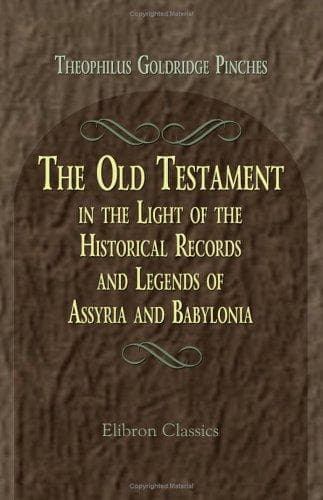
The Old Testament in the Light of the Historical Records and Legends of Assyria and BabyloniaPinches, Theophilus G. (Theophilus Goldridge)
Religion
The Old Testament in the Light of the Historical Records and Legends of Assyria and Babylonia
Pinches, Theophilus G. (Theophilus Goldridge)
Bible. Old Testament -- Criticism, interpretation, etc.
How it is that Tiglath-pileser III. of Assyria was called Pûlu is not
known. The name only occurs, in native documents, in the Babylonian Canon
of kings—to all appearance that from which the Canon of Ptolemy was
copied. It is therefore practically certain that he only bore this name
officially in Babylonia. Probably the most likely explanation is, that it
was his original name, though it may have been given him by the compiler
of the canon (supposing that he was a man who had no great admiration for
the Assyrian conqueror) as a scornful expression, _bûlu_ (which may also
be read _pûlu_) meaning “the wild animal.” It occurs, however, as a
personal name in the inscriptions of Assyria at least twice, the bearer of
it being in one case a charioteer, one of nine officials of “the
Ḫuḫamite.”
The fact that the name Pûlu (in the Canon of Ptolemy Poros), applied to
Tiglath-pileser, occurs only in a Babylonian document, suggests that the
reference to the Assyrian conqueror in 2 Kings xv. 19 and 1 Chron. v. 26
are due to a Babylonian source, though, as it is the name by which he is
at first called by the writer of the 2nd Book of Kings, this is a
confirmation of the explanation that it was his original name. The glory
attached to the name Tiglath-pileser in Assyrian history probably accounts
for his having ultimately adopted the latter.
“On the 25th day of Tebet Šulmanu-ašarid (Shalmaneser) sat on the throne
in Assyria. He destroyed Šabara’in.” (Babylonian Chronicle.)
“In the eponymy of Bêl-ḫarran-bêl-uṣur, of the city of Gozan, To
the city ... Šalmanu-ašarid sat upon the throne.
In the eponymy of Marduk-bêl-uṣur, of the city of Amedi, In the
land.
In the eponymy of Maḫdê, of the city of Nineveh, To....
In the eponymy of Aššur-ḫalṣani (?), of the city of Kalzi, To....
In the eponymy of Šalmanu-ašarid, king of Assyria, To....”
(Eponym Canon with historical notices.)
These two extracts give practically all that is known of the important
reign of Shalmaneser IV. from native sources. The first is from the
Babylonian Chronicle, and its brevity in all likelihood indicates the
amount of sympathy that the Babylonians had for this king. Short as it is,
however, it is probably of as much value historically as the Assyrian
Eponym Canon in its present state, even including the restorations from
that without historical notices. The completion of this important document
from additional fragments and duplicates is greatly to be wished.
It is therefore from the Old Testament and Josephus that we get the
fullest history of the reign of this king. How it is that no records have
been found is not known. They may have been destroyed, or nothing very
extensive may have been written. That at least something of the kind
existed is indicated by the fact that the late George Smith refers to at
least one document, the whereabouts of which at present is not known.
Public-domain text, read in full here on John Shaqi.
Reviews
Reviews
No reviews yet
Be the first to share your thoughts on this work.
Elsewhere in the archive
Join the Discussion
Join the discussion
Sign in to leave a comment or review.
Sign InorCreate an account