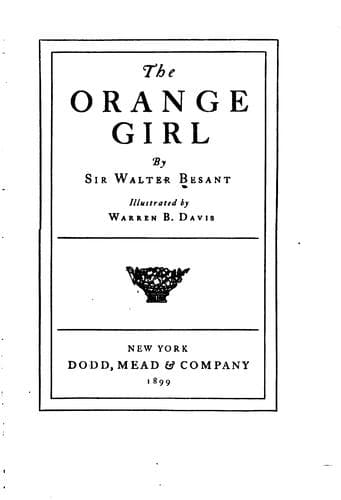
London (England) -- History -- 18th century -- Fiction
It was certain that Jenny had been born and brought up in this vile
receptacle or Temple of Vice. Many people were found who had
recollections of Jenny as a child playing in the gutter, or on the steps
of St. Giles's Church. These recollections were of an edifying nature.
One gentleman, of an aspect which we call smug--somewhat resembling, in
fact, my cousin Matthew at his earliest and best--related in my hearing
that he had addressed the child, and on hearing that her ambition was to
become an Orange Girl at Drury Lane Theatre, had warned her against the
perils of that path; unhappily without effect, except that while he was
exhorting her to a godly life, his tears were checked by the theft of
his pocket-handkerchief. And so on: and so on; because the occasion gave
an opportunity for securing a momentary distinction, and when the
imagination is fired the tongue is loosed.
Again, there is in the English mind something particularly repellant in
the life and the acts of the informer. Now it cannot be denied that in
my Trial, Jenny figured as one who had turned against her old friends
and associates; had used her knowledge to secure their arrest; and had
induced her mother and sister and at least one of the rogues of the
Black Jack, to join her in giving evidence against the conspirators. So
that when the news was spread abroad that her house, as well as the
Black Jack, had been wrecked and the contents destroyed there was at
first a strong feeling among many that this was a kind of wild justice
which she deserved, because she ought not to have turned against her
friends. As for the man for whose sake she did it, you may be sure that
the motive commonly attributed to her was such as would naturally
commend itself to the majority. That any woman should be so deeply moved
by generosity of heart, by love of justice, by honest indignation
against so foul a conspiracy as to resolve, at all risks and hazards, to
defeat the object of the villains, and to prevent the destruction of an
innocent man, required too high a flight to make it possible to be
considered by the common sort--I mean, not the poor, but the common sort
of 'respectable' burgesses; the folk of the coffee-house and the club.
The world always accepts the worst where it ought to believe the best.
And the wickedness of the natural man is never so strongly demonstrated
as when he is searching for motives. In a word, it was pretended and
believed, that in order to rescue her lover--a broken-down gentleman and
a highwayman--from the charge of robbery, which could only be proved by
the witnesses taking false names, in order to protect themselves, being
unfortunately rogues themselves, she brought a charge against them of
conspiracy and exposed their true names and their history, which she
could only effect by the knowledge she got from the Black Jack and the
assistance of her mother: that her lover, it was true, was cast loose
upon the world again; but that the innocence of those four persons,
Public-domain text, read in full here on John Shaqi.
Reviews
Reviews
No reviews yet
Be the first to share your thoughts on this work.
Elsewhere in the archive
Join the Discussion
Join the discussion
Sign in to leave a comment or review.
Sign InorCreate an account