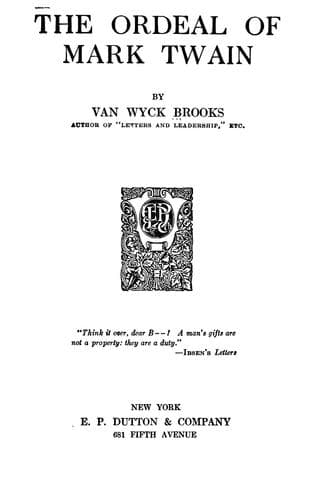
Authors, American -- 19th century -- Biography; Twain, Mark, 1835-1910
Thus it came to pass, in these middle years of his life, that while in
the old world virtually every writer of eminence was inalterably set
against the life-destroying tendencies of capitalistic industrialism,
Mark Twain found himself the spokesman of the Philistine majority, the
headlong enthusiast for what he called "the plainest and sturdiest and
infinitely greatest and worthiest of all the centuries the world has
seen." The second half of "Life on the Mississippi" glows with
complacent satisfaction over the march of what he was pleased to accept
as progress, the purely quantitative progress of an expanding
materialism; it bristles with statistics, it resembles, in fact, nothing
so much as the annual commercial supplement of a Western newspaper. In
1875, when he was on one of his many pinnacles of prosperity, he wrote a
Utopia, "The Curious Republic of Gondour." And what was the sort of
improvement he showed there that he desired for the world? He suggested
that "for every fifty thousand 'sacos' a man added to his property he
was entitled to another vote." The fable was published anonymously: the
great democratic humorist could hardly father in public the views of the
framers of the American Constitution. But we can see from this how far
Mark Twain, like the chameleon which he said man was, had taken the
colors of the privileged class which the new industrial régime had
brought forth and of which his own material success had made him a
member.
His essential instinct, as we know, was antagonistic to all this; his
essential instinct, the instinct of the artist, placed him naturally in
the opposition with all the great European writers of his age. Turn to
his letters and see what he says in the privacy of his correspondence
and memoranda. He is strongly against the tariff; he vehemently defends
the principle of the strike and woman suffrage; he is consistently for
the union of labor as against the union of capital; he bitterly regrets
the formation of the Trusts; "a ruling public and political aristocracy
which could create a presidential succession" is, he says, neither more
nor less than monarchism. He deals one blow after another against the
tendencies of American imperialism, against the Balance of Power,
against the Great Power system. And hear what he writes in 1887: "When I
finished Carlyle's 'French Revolution' in 1871, I was a Girondin; every
time I have read it since I have read it differently ... and now I lay
the book down once more, and recognize that I am a Sansculotte!--and not
a pale, characterless Sansculotte, but a Marat." All this in the privacy
of his correspondence! In public, he could not question, he did not wish
to question, the popular drift of his age, the popular cry of his age,
"Nothing succeeds like success"! Shall I be told that he created quite a
scandal in Hartford by deserting the Republican party and becoming a
Mugwump? At least he was in very respectable company. In his impetuous
Public-domain text, read in full here on John Shaqi.
Reviews
Reviews
No reviews yet
Be the first to share your thoughts on this work.
Elsewhere in the archive
Join the Discussion
Join the discussion
Sign in to leave a comment or review.
Sign InorCreate an account