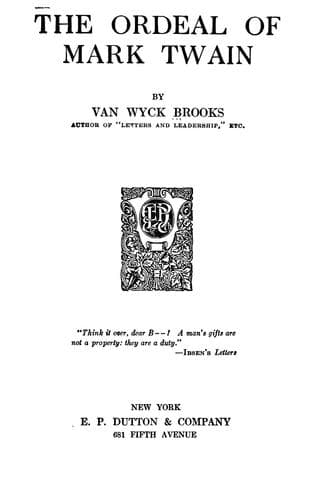
Authors, American -- 19th century -- Biography; Twain, Mark, 1835-1910
As we have seen, personal and private loyalties had come to take
precedence in Mark Twain's mind over all other loyalties; no ideal, with
him, no purpose, no belief, was to be weighed for a moment if the
pursuit of it, or the promulgation of it, was likely to hurt the
feelings of a friend. Quite early in his career he planned a book on
England and collected volumes of notes for it only to give over the
scheme because he was afraid his criticism or his humor would "offend
those who had taken him into their hearts and homes." Imagine Emerson
having been prevented by any such consideration from writing "English
Traits"! I have pointed out how utterly Mark Twain had failed to rise to
the conception of literature as a great impersonal social instrument,
how immersed he was in the petty, provincial values of a semi-rustic
bourgeoisie among whom the slightest expression of individuality was
regarded as an attack on somebody's feelings or somebody's pocket-book.
As time had gone on, therefore, and his circle of friends had come to
include most of the main pillars of American society, it had become less
and less possible for the tongue-tied artist in him to assert itself
against the complacent pioneer. We know what his instinctive religious
tendency was; yet he had a fatal way of entangling his loyalties with
very dogmatic ministers of the gospel. We know what his instinctive
economic and political tendencies were; yet the further he advanced in
his business activities, and the more he failed in them, the more deeply
he involved himself with all the old freebooters of capitalism. How,
then, could he have developed and expressed any of these tendencies in
his writings? He whose "closest personal friend and counselor for more
than forty years," as Mr. Paine says, was the pastor of what he had
once, in a moment of illumination, called the "Church of the Holy
Speculators" in Hartford; who, from the depths of his gratitude, was to
say of H.H. Rogers, when the latter rescued him in his bankruptcy, "I
never had a friend before who put out a hand and tried to pull me ashore
when he found me in deep water"--this man had given too many hostages to
the established order ever seriously to attack that order. His dominant
self had no desire to attack it; his dominant self was part and parcel
of it. Some one offered him as a publisher a book arraigning the
Standard Oil Co. "I wanted to say," he wrote, "the only man I care for
in the world, the only man I would give a d---- for, the only man who is
lavishing his sweat and blood to save me and mine from starvation is a
Standard Oil magnate. If you know me, you know whether I want the book
or not." His obligations had gradually come to be innumerable. We find
him urging Mr. Rogers to interest the Rockefellers "and the other
Standard Oil chiefs" in Helen Keller, trying to inveigle Carnegie into
his moribund publishing business as a partner, accepting from "Saint
Public-domain text, read in full here on John Shaqi.
Reviews
Reviews
No reviews yet
Be the first to share your thoughts on this work.
Elsewhere in the archive
Join the Discussion
Join the discussion
Sign in to leave a comment or review.
Sign InorCreate an account