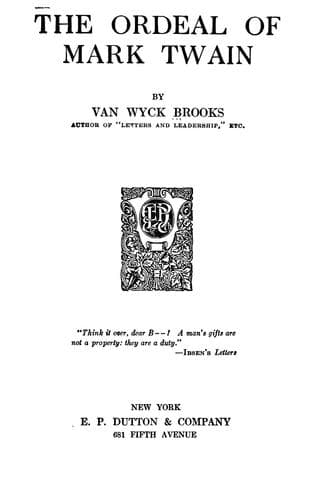
Authors, American -- 19th century -- Biography; Twain, Mark, 1835-1910
piece of machinery, something no longer himself but the embodiment of
the whole industrial epoch? It is enough to note how capable he was of
the elevations of religion, and what it was that caused those elevations
in him. It was not literature. Paige, the inventor of this machine, he
called "a poet, a most great and genuine poet, whose sublime creations
are written in steel": which leaves little to be said about the poets
who write in mere words. And, in fact, on the occasion of Walt Whitman's
seventieth birthday, Mark Twain expressed, in a way, his opinion of such
people. He congratulated the poet for having lived in an age that had
witnessed, among other benefactions, "the amazing, infinitely varied and
innumerable products of coal-tar"; he neglected to congratulate the age
for having produced Walt Whitman.
CHAPTER VII
THE PLAYBOY IN LETTERS
"How can great minds be produced in a country where the test
of a great mind is agreeing in the opinions of small minds?"
JOHN STUART MILL.
We have now watched the gradual building up and the final flowering in
Mark Twain of the personality which his mother, his wife, all America
indeed, had, so to speak, wished upon him. It came into existence, we
recall, that personality, through his mother's ruthless opposition to
the poet in him, through the shock of his father's death; and every
influence he had encountered in life had confirmed him in the pursuit of
opulent respectability. We have seen, however, that this was not the
real Mark Twain, this money-making, success-loving, wire-pulling
Philistine; it was a sort of dissociated self, the race-character, which
had risen in him with the stoppage of his true individuality. The real
Mark Twain had been arrested in his development, the artist had remained
rudimentary; and this is the Mark Twain we have to consider now. "What a
child he was," says Mr. Paine, "always, to the very end!" It was this
childishness which caused and which explains his lack of spiritual
independence as a man and which accounts for the character of his work
as a writer.
Public-domain text, read in full here on John Shaqi.
Reviews
Reviews
No reviews yet
Be the first to share your thoughts on this work.
Elsewhere in the archive
Join the Discussion
Join the discussion
Sign in to leave a comment or review.
Sign InorCreate an account