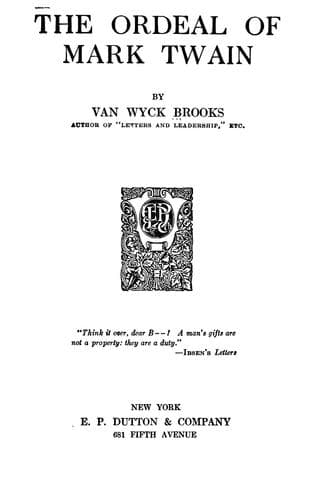
Authors, American -- 19th century -- Biography; Twain, Mark, 1835-1910
women "females": indignation was Mark Twain's habitual attitude toward
the modes of the past; and foreign languages never ceased to be
infinitely ludicrous to him just because they weren't English. These are
all signs of the young schoolboy who has begun to take a pride in his
first compositions and who has become suddenly aware of words; and I
suggest that Mark Twain never reached the point of being more at home in
the language of civilization than that. His preoccupation with
letter-perfection is thrown into a significant light by the style of
"Huckleberry Finn." If the beauty and the greatness of that book spring
from the joyous freedom of the author, is it not because, in throwing
off the bonds of the bourgeois society whose mold he had been obliged to
take, he was reverting not only to a frame of mind he had essentially
never outgrown, but to a native idiom as well?
Mark Twain has told us again and again that in all vital matters a man
is the product of his training. If we wanted further proof that his
taste was simply rudimentary we might observe that it developed in some
slight measure, though very slightly and inconclusively, the "training"
having come too late. Mr. Paine tells us, for example, that twelve years
after the pilgrimage of "The Innocents Abroad," he found the new, bright
copies of the old masters no longer an improvement on the originals,
although he still did not care for the originals. Indeed, if we wish to
understand the reason for the barbarous contempt he displays,
obtrusively in his earlier work, for the historic memorials of the human
spirit in Europe, we have only to turn to the postscript of "The
Innocents Abroad" itself. "We were at home in Palestine," says Mark
Twain. "It was easy to see that that was the grand feature of the
expedition. We had cared nothing much about Europe. We galloped through
the Louvre, the Pitti, the Uffizi, the Vatican--all the galleries.... We
examined modern and ancient statuary with a critical eye in Florence,
Rome, or anywhere we found it, and praised it if we saw fit, and if we
didn't we said we preferred the wooden Indians in front of the cigar
stores of America. But the Holy Land brought out all our enthusiasm. We
fell into raptures by the barren shores of Galilee; we pondered at Tabor
and at Nazareth.... Yes, the pilgrimage part of the excursion was its
pet feature--there is no question about that." Why? Why were Paris and
Rome nothing to Mark Twain but the material for an indifferent, a
hostile persiflage, while Jerusalem was "full of poetry, sublimity, and,
more than all, dignity"? It was because the only education he had known
was that "Hebraic" education which led Matthew Arnold to say that the
American people of his time were simply the English middle class
transplanted. "To 'fear God and dread the Sunday School,'" he wrote to
Mr. Howells once, "exactly described that old feeling which I used to
have." But had he ever outgrown this fear and dread? Had not his wife
Public-domain text, read in full here on John Shaqi.
Reviews
Reviews
No reviews yet
Be the first to share your thoughts on this work.
Elsewhere in the archive
Join the Discussion
Join the discussion
Sign in to leave a comment or review.
Sign InorCreate an account