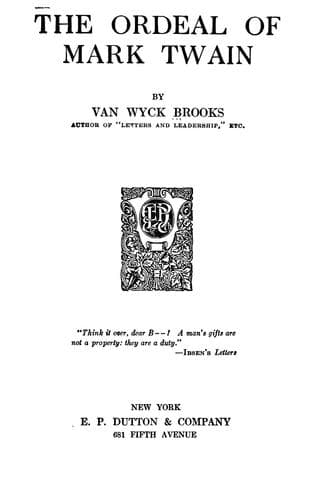
Authors, American -- 19th century -- Biography; Twain, Mark, 1835-1910
If this explanation is the correct one, it is easy indeed to determine
the measure of Mark Twain's maturity, to prove that he was at the same
time a born artist and one who never developed beyond the primitive
stage. Only once, and with a significant result in his own confession,
have we found him working at literature as the artist works. But think
of the care he lavished upon lecturing and oral story-telling! He was,
says Mr. Howells, "the most consummate public performer I ever saw....
On the platform he was the great and finished actor which he probably
would not have been on the stage." And to what was this eminence
due?--"his carefully studied effects." This man, who was capable of all
but "yelling" his books into a phonograph, approached the platform with
all the circumspection of a conscious master: there we find him prudent,
prescient, self-respectful, deliberately taking pains, as he shows in
one of his letters, to rest and equip himself beforehand. "Unless I get
a great deal of rest," he says, and he makes no jokes now about his
"laziness," "a ghastly dullness settles down upon me on the platform,
and turns my performance into work, and hard work, whereas it ought
always to be pastime, recreation, solid enjoyment." There is the voice
of the artist, the prompting of the true craftsman's conscience. I have
said that he was indifferent to technique, abnormally incurious, in
fact, of all the means of the literary art. But who that has read his
essay, "How to Tell a Story," will forget the proud skill of the
_raconteur_ of "The Golden Arm"? Those who imagine that an artist is
just an inspired child of nature might well consider the attitude of
mind revealed in this little essay. Mark Twain first heard the story of
the "Golden Arm" from an old negro to whose cabin he used to resort as a
boy in Hannibal; and just as we have seen him reverent in the Holy Land
because of the initiation of the Sunday School, so now we see him
reverent in art because of the initiation of that first master who had
remained, indeed, save for Horace Bixby, the pilot, his only master. To
tell that story rightly, to pause just long enough in just the proper
places, to enunciate each word with just the accurate emphasis, and at
last--oh! so warily, oh! so carefully, so cautiously, with such control,
to spring that final effect of horror!--there was something worthy of a
man's passionate endeavor! Did not Mark Twain assert again and again, in
his old age, that no one can rise above the highest limit attainable
through the "outside helps afforded by the ideals, influences, and
training" of the society into which he is born? Who, in the Gilded Age
of America, cared for literature, cared for it enough to celebrate it,
to glorify it, to live it? What master in the highest of the arts had
Mark Twain ever found comparable in relative authority, in essential
authority, with that old negro _raconteur_, that old pilot of the
Public-domain text, read in full here on John Shaqi.
Reviews
Reviews
No reviews yet
Be the first to share your thoughts on this work.
Elsewhere in the archive
Join the Discussion
Join the discussion
Sign in to leave a comment or review.
Sign InorCreate an account