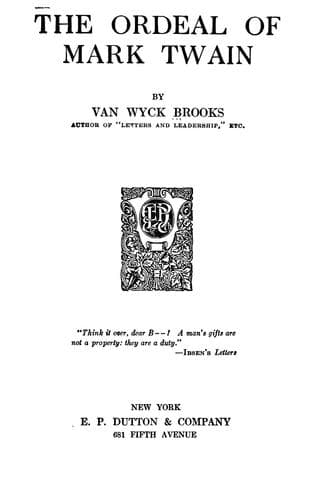
Authors, American -- 19th century -- Biography; Twain, Mark, 1835-1910
It was one of Mark Twain's favorite fancies, Mr. Paine says, that life
should begin with old age and progress backwards. We can understand it
now; we can understand why his mind was essentially retrospective and
why so much of his writing deals with his childhood. The
autobiographical impulse is normal in old age: when men cannot build on
hope they build on memory, their minds regress into the past because
they no longer have a future. It is generally understood, therefore,
that when people in middle age occupy themselves with their childhood it
is because some central instinct in them has been blocked by either
internal or external obstacles: their consciousness flows backward until
it reaches a period in their memory when life still seemed to them open
and fluid with possibilities. Who does not see in the extraordinary
number of books about boys and boyhood written by American authors the
surest sign of the prevalence of that arrested moral development which
is the result of the business life, the universal repression in the
American population of all those impulses that conflict with commercial
success? So it was with Mark Twain. In him the autobiographical impulse,
characteristic of old age, awoke very early: as far back as 1880 we find
him "attempting, from time to time," according to Mr. Paine, "an
absolutely faithful autobiography"; and he resumed the attempt in 1885,
at the time when he was assisting Grant with his Memoirs. It remained
his dominant literary impulse. "Earn a character if you can, and if you
can't," says Pudd'nhead Wilson, "then assume one." Mark Twain had
"assumed" the character of his middle years; he had only truly lived, he
had only been himself, as a child, and the experience of childhood was
the only experience he had assimilated. That is why he was perpetually
recurring to his early life in Hannibal, why the books he wrote _con
amore_ were books about childhood, and why he instinctively wrote not
only about, but also for, children. By doing so he knew, or something
in him knew, what many another American author has known since, that he
was capturing the whole public. Ten million business men--that was the
public, the masculine public, of Mark Twain's time. And are not business
men in general, in a sense not quite intended by the coiner of the
phrase, "children of a larger growth"?
Public-domain text, read in full here on John Shaqi.
Reviews
Reviews
No reviews yet
Be the first to share your thoughts on this work.
Elsewhere in the archive
Join the Discussion
Join the discussion
Sign in to leave a comment or review.
Sign InorCreate an account