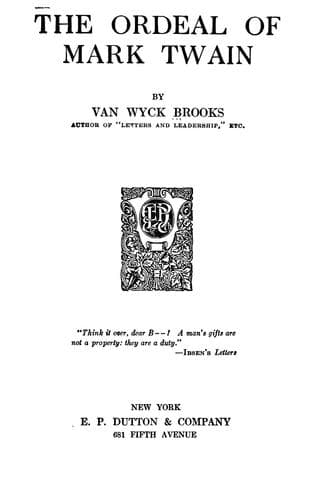
Authors, American -- 19th century -- Biography; Twain, Mark, 1835-1910
At the circus, no doubt, you have watched some trained lion going
through the sad motions of a career to which the tyrannical curiosity of
men has constrained him. At times he seems to be playing his part with a
certain zest; he has acquired a new set of superficial habits, and you
would say that he finds them easy and pleasant. Under the surface,
however, he remains the wild, exuberant creature of the jungle. It is
only thanks to the eternal vigilance of his trainers and the
guiding-lines they provide for him in the shape of the ring, the rack
and all the rest of the circus-paraphernalia that he continues to enact
this parody of his true life. Have his instincts been modified by the
imposition of these new habits? Look at him at the moment when the
trainer ceases to crack his whip and turns his back. In a flash another
self has possessed him: in his glance, in his furtive gesture you
perceive the king of beasts once more. The sawdust of the circus has
become the sand of the desert; twenty thousand years have rolled back in
the twinkling of an eye.
So it was with Mark Twain. "We have no _real_ morals," he wrote in one
of his later letters, "but only artificial ones, morals created and
preserved by the forced suppression of natural and healthy instincts."
Now that is not true of the man who is master of himself. The morality
of the free man is not based upon the suppression of his instincts but
upon the discreet employment of them: it is a real and not an artificial
morality, therefore, because the whole man subscribes to it. Mark Twain,
as we have seen, had conformed to a moral régime in which the
profoundest of his instincts could not function: the artist had been
submerged in the bourgeois gentleman, the man of business, the
respectable Presbyterian citizen. To play his part, therefore, he had to
depend upon the cues his wife and his friends gave him. Here we have the
explanation of his statement: "Outside influences, outside
circumstances, wind the man and regulate him. Left to himself, he
wouldn't get regulated at all, and the sort of time he would keep would
not be valuable." We can see from this how completely his conscious self
had accepted the point of view of his trainers, how fully he had
concurred in their desire to repress that unmanageable creative instinct
of his, how ashamed, in short, he was of it. Nevertheless, that
instinct, while repressed, while unconscious, continued to live and
manifest itself just the same. We shall see that in the end, never
having been able to develop, to express itself, to fulfill itself, to
air itself in the sun and the wind of the world, it turned as it were
black and malignant, like some monstrous, morbid inner growth, poisoning
Mark Twain's whole spiritual system. We have now to note its constant
blind efforts to break through the censorship that had been imposed on
it, to cross the threshold of the unconscious and play its part in the
Public-domain text, read in full here on John Shaqi.
Reviews
Reviews
No reviews yet
Be the first to share your thoughts on this work.
Elsewhere in the archive
Join the Discussion
Join the discussion
Sign in to leave a comment or review.
Sign InorCreate an account