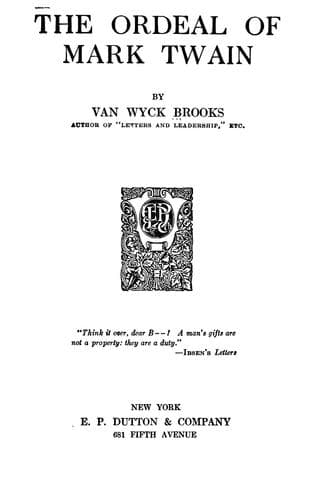
Authors, American -- 19th century -- Biography; Twain, Mark, 1835-1910
It." "Scattered to the ends of the earth, or prematurely aged or
decrepit--or shot or stabbed in street affrays--or dead of disappointed
hopes and broken hearts--all gone, or nearly all, victims devoted upon
the altar of the golden calf." We could not have a more conclusive proof
of the total atrophy of human nature this old Nevada life entailed.
Innumerable repressions, I say, produced the fierce intensity of that
life, which burnt itself out so quickly. We can see this, indeed, in the
fact that it was marked by an incessant series of eruptions. The
gold-seekers had come of their own volition, they had to maintain an
outward equilibrium, they were sworn, as it were, to a conspiracy of
masculine silence regarding these repressions, of which, in fact, in the
intensity of their mania, they were scarcely aware. Nevertheless, the
human organism will not submit to such conditions without registering
one protest after another; accordingly, we find that in the mining-camps
the practical joke was, as Mr. Paine says, "legal tender," profanity was
almost the normal language, and murder was committed at all hours of the
day and night. Mark Twain tells how, in Virginia City, murders were so
common--that they were scarcely worth more than a line or two in the
newspaper, and "almost every man" in the town, according to one of his
old friends, "had fought with pistols either impromptu or premeditated
duels." We have just noted that for Mark Twain this life was a life of
chronic nervous exasperation. Can we not say now that, in a lesser
degree, it was a life of chronic nervous exasperation for all the
pioneers?
But why? What do we mean when we speak of repressions? We mean that
individuality, the whole complex of personal desires, tastes and
preferences, is inhibited from expressing itself, from registering
itself. The situation of the pioneers was an impossible one, but,
victims as they were of their own thirst for gold, they could not
withdraw from it; and their masculine pride prevented them even from
openly complaining or criticising it. In this respect, as I have already
pointed out, their position was precisely parallel to that of soldiers
in the trenches. And, like the soldiers in the trenches, they were
always on the verge of laughter, which philosophers generally agree in
calling a relief from restraint.
Public-domain text, read in full here on John Shaqi.
Reviews
Reviews
No reviews yet
Be the first to share your thoughts on this work.
Elsewhere in the archive
Join the Discussion
Join the discussion
Sign in to leave a comment or review.
Sign InorCreate an account